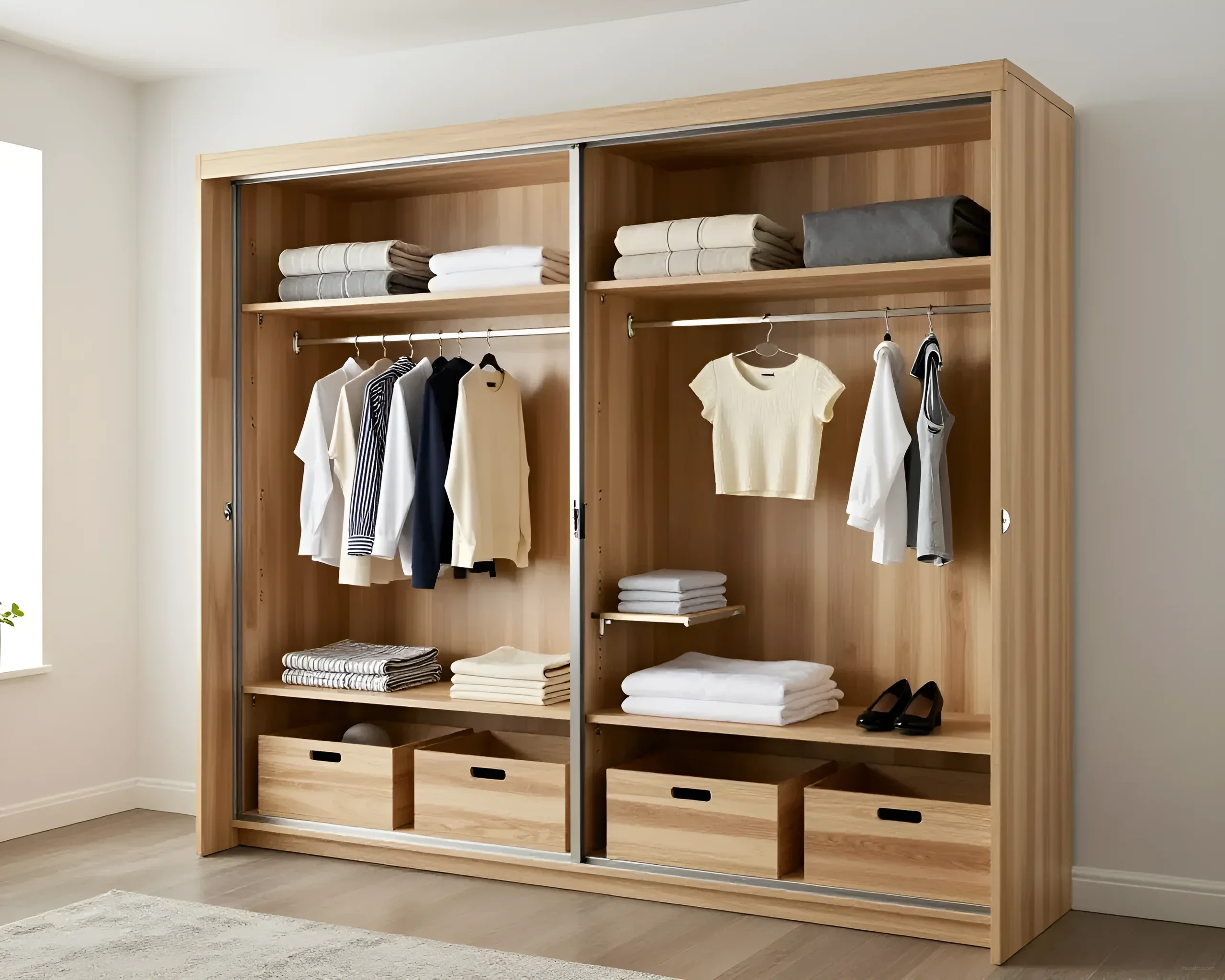
The sliding wardrobe has long ceased to be just a piece of furniture for storing clothes, turning into a high-tech space optimization system. The main advantage of such a design is sliding doors, which do not require additional space for opening, making them an ideal solution even for the narrowest corridors and small bedrooms. Unlike hinged models, a sliding wardrobe allows you to utilize every centimeter from floor to ceiling, hiding not only wardrobes but also household appliances, ironing boards, and even workspaces behind aesthetic facades. The right choice of a sliding wardrobe is an investment in order and comfort in your home for decades to come.
Types and Categories of Sliding Wardrobes: Which One to Choose for Your Room
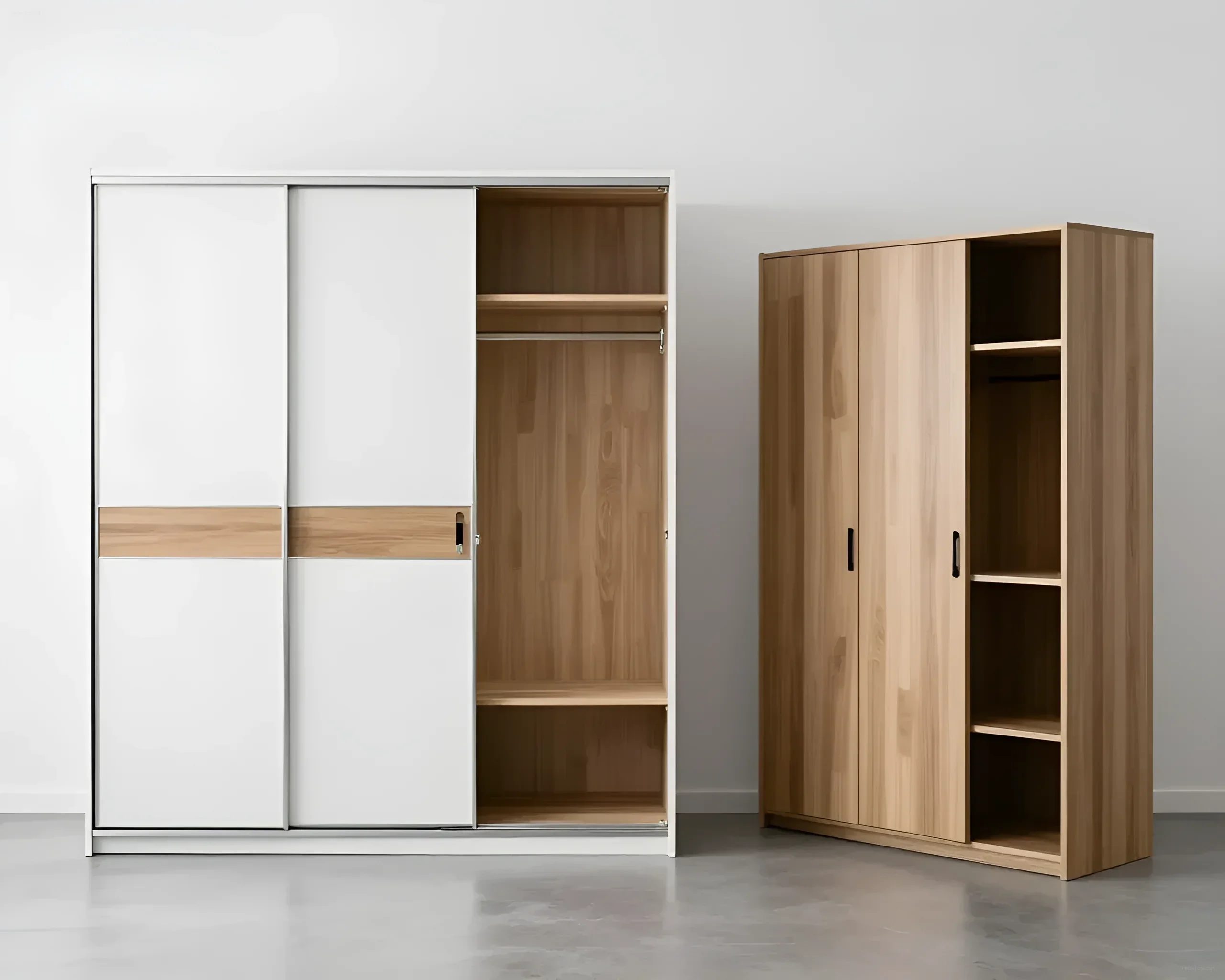
Before choosing a color or handles, you need to decide on the type of construction. Sliding wardrobes are divided into two main categories: freestanding and built-in. Each type has its own technical features and operational nuances.
- Freestanding (standalone) wardrobes. This is a complete piece of furniture with its own frame: side walls, back panel, floor, and roof. Pros: such a wardrobe can be moved, transported to another apartment when moving, and it does not depend on the unevenness of the walls. Cons: it takes up a little more space due to the thickness of the walls and gaps, and it costs more due to higher material consumption.
- Built-in sliding wardrobes. In this design, the walls of your room serve as the walls, floor, and ceiling. Essentially, only internal partitions and a sliding door system are installed. Pros: maximum space saving, no dust collectors between the wardrobe and the wall, lower price due to the absence of an external frame. Cons: cannot be moved, installation requires relatively even walls, and it is fixed “permanently” to the surfaces.
By their shape, sliding wardrobes are also classified as:
- Straight. A classic option along the wall. Universal for any room.
- L-shaped (corner). Consists of two wardrobes joined at the corner. Excellent space savers in corner areas.
- Diagonal (trapezoidal). Cuts across the corner of the room diagonally. Very spacious, often used as mini-wardrobes, but require a large area.
- Radius. Have curved facades (convex or concave). Look impressive and modern, but cost significantly more due to the complexity of manufacturing guides and doors.
Materials for the Body and Facades: Understanding the Pros and Cons
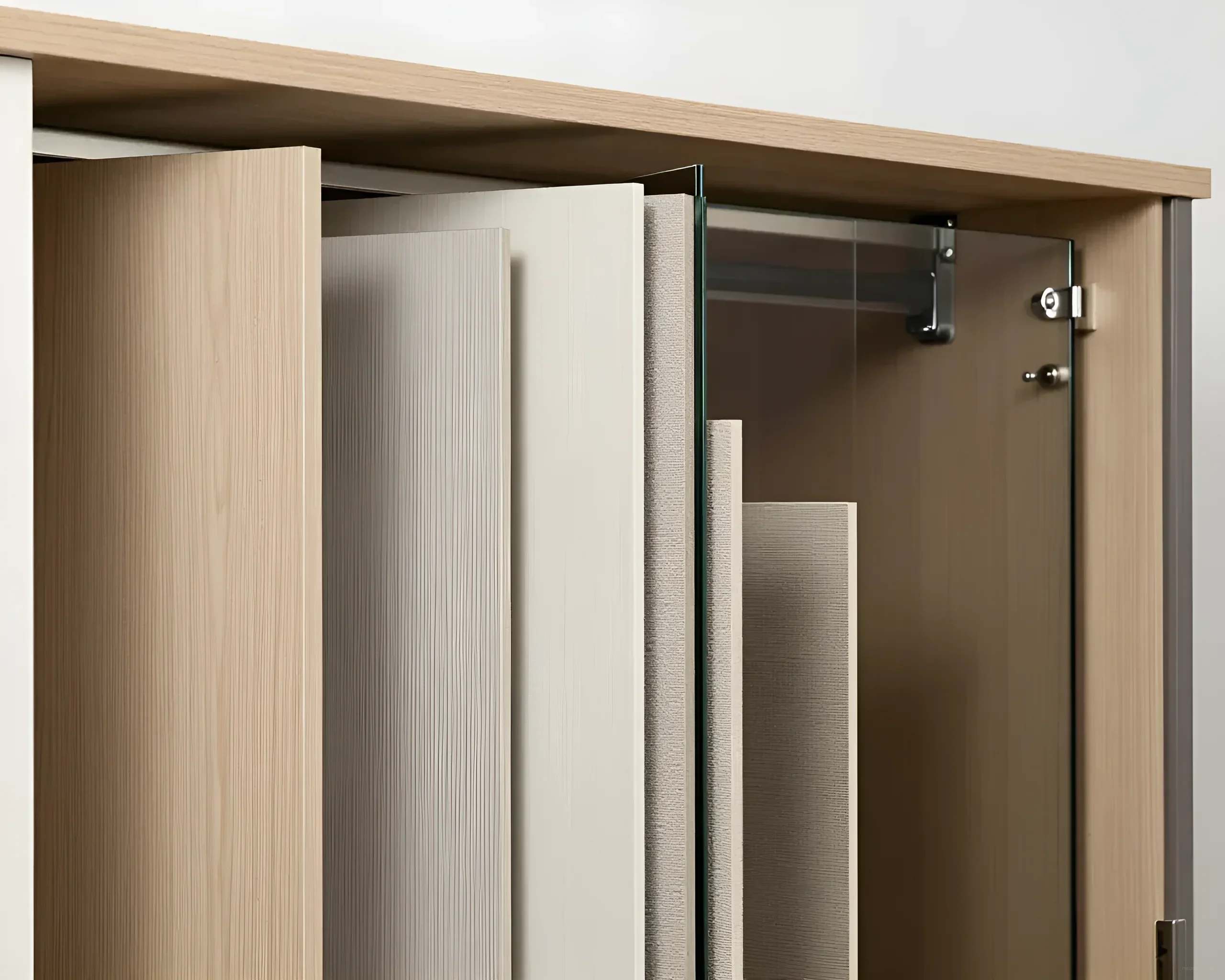
The durability of a wardrobe directly depends on what it is made of. The main load falls on the frame, and the aesthetics on the facades. Let’s look at the main materials used in modern production.
Body materials:
- Laminate particleboard (LDSP). The most popular material. When choosing, pay attention to the formaldehyde emission class – only E1 or E0.5 is acceptable for residential premises. The optimal board thickness for walls is 16–18 mm. It is important to check the quality of the edging: it should be made of PVC (2 mm thick for external edges), not paper (melamine), which peels off quickly.
- MDF (medium-density fiberboard). A denser and more environmentally friendly material, resistant to moisture. MDF allows for milling (patterns) on the surface. Usually, only facades are made from it, as making the entire body from MDF is prohibitively expensive.
- Solid wood. An elite option. Requires special care and a stable microclimate (humidity 40-60%), otherwise the doors can warp and stop sliding smoothly on the tracks.
Facade materials:
- Mirror. Visually expands the space. It must have a protective film on the back (so that shards do not scatter upon impact).
- Lacobel. Opaque glass painted on one side. Looks stylish and is easy to clean.
- Sandblasted pattern. Matte patterns on a mirror. Beautiful, but requires careful maintenance, as fingerprints are more visible on a matte surface.
- Soft panels (leather, eco-leather). Add coziness and status to the interior, often used in bedrooms.
How to Choose a Sliding Wardrobe: Key Criteria for the Perfect Purchase
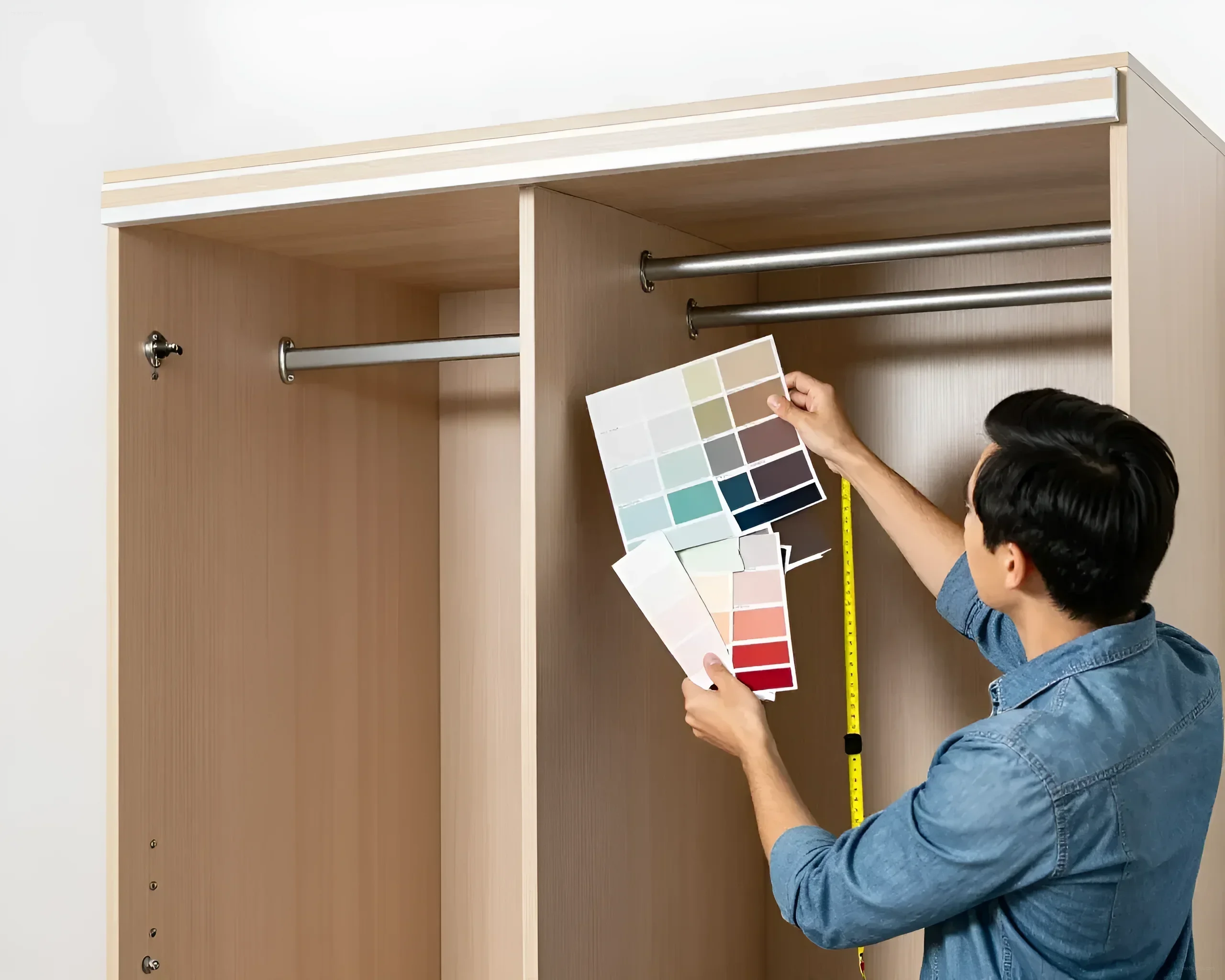
To ensure the wardrobe doesn’t start creaking and falling apart after a year, you need to look “at the root,” namely – at the hardware and mechanisms. The sliding door system is the heart of a sliding wardrobe.
1. Profile type (door frame):
- Steel profile. Budget option. Shorter lifespan, possible noise when doors move. Steel deforms more easily under the weight of heavy contents.
- Aluminum profile. More rigid, durable, and quiet. Allows for doors up to 3–5 meters high. Aluminum systems can be anodized (matte), painted, or coated with a wood-look film.
2. Running system:
- Bottom-supported system. The weight of the door rests on the lower rollers, which move along the guide. This is reliable and affordable. The main nuance is that dust gets into the lower track, which needs to be cleaned periodically with a vacuum cleaner.
- Top-hung system. Doors “hang” on the upper guide. The advantage is that there are no thresholds on the floor, but such a system requires a very strong ceiling (or a wooden beam backing) and costs more.
3. Rollers. The best choice is rollers with bearings and a Teflon or nylon coating. Pure plastic without bearings wears out quickly and starts to make noise. A good roller should have a spring for shock absorption.
Dimensions and Sizes: Calculating the Ideal Sliding Wardrobe
Ergonomics is fundamental. If you make a mistake with the dimensions, using the wardrobe will be inconvenient. Note the key parameters:
- Depth. The standard overall depth is 60 cm. However, remember that 10 cm is “eaten up” by the sliding door system. This means the usable shelf depth will be 50 cm. This is enough for hangers. If space is limited and you order a wardrobe with a depth of 40–45 cm, you will have to use pull-out micro-lifts (end hangers) instead of a regular rod.
- Height. Limited only by your ceiling height. If the ceilings are higher than 2.8 m, it is better to make the wardrobe with mezzanines and separate doors at the top, as a single door panel of such height will be too heavy and unstable.
- Door width. The optimal width of one leaf is from 60 to 90 cm. A door less than 50 cm can “jump” and fall out of the track, and wider than 100–110 cm is too heavy, creating a huge load on the rollers and profile.
- Plinth. The height of the plinth (base under the wardrobe) is usually 7–10 cm. It is needed so that the doors do not catch the floor covering and so that the wardrobe can be pushed close to the wall without removing the skirting board.
Internal Filling of a Sliding Wardrobe: Planning Functionality
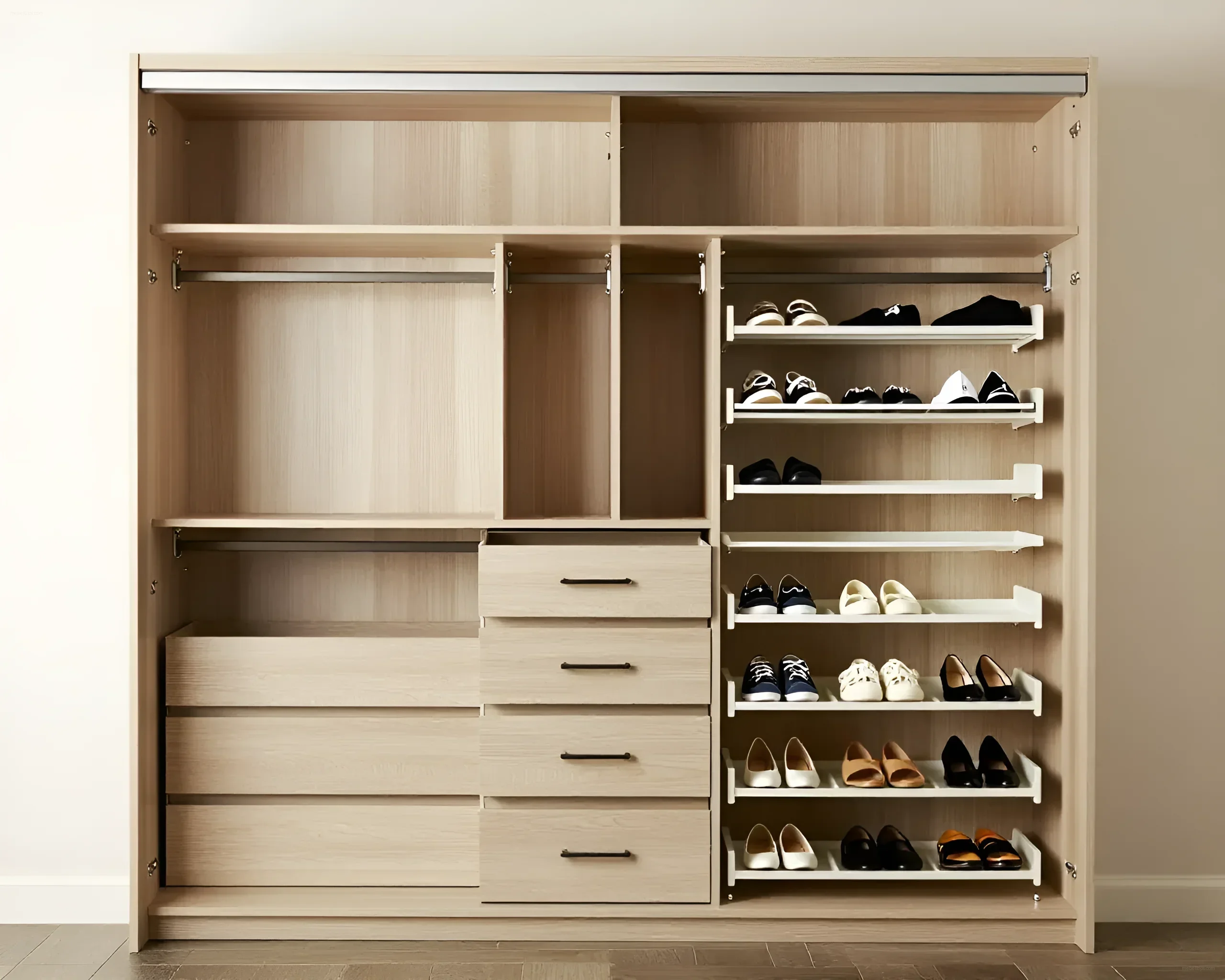
The internal space of a wardrobe is conventionally divided into three zones: upper, middle, and lower. Proper distribution of items will help maintain order effortlessly.
Lower zone (up to 80 cm from the floor):
- Shoe shelves (inclined or pull-out mesh).
- Space for storing a vacuum cleaner, suitcases, or heavy boxes.
- Pull-out drawers for linen (it is better to use full extension slides with soft-close mechanisms).
Middle zone (from 80 to 190 cm):
- Clothes rods. For short items (shirts, jackets), you need 100–110 cm of height; for long items (coats, dresses) – 150–160 cm.
- Pantograph. This is a “furniture lift” that allows you to lower a clothes rod from under the very ceiling. Indispensable for tall wardrobes.
- Trouser and tie racks. Pull-out elements that save space and prevent fabric creasing.
- Shelves for knitwear. The optimal distance between shelves is 30–35 cm.
Upper zone (mezzanines):
- Large shelves for blankets, pillows, seasonal clothing, and sports equipment. Here, the shelf height can be 40–50 cm.
Sliding Wardrobe Care: Secrets of Durability and Beauty
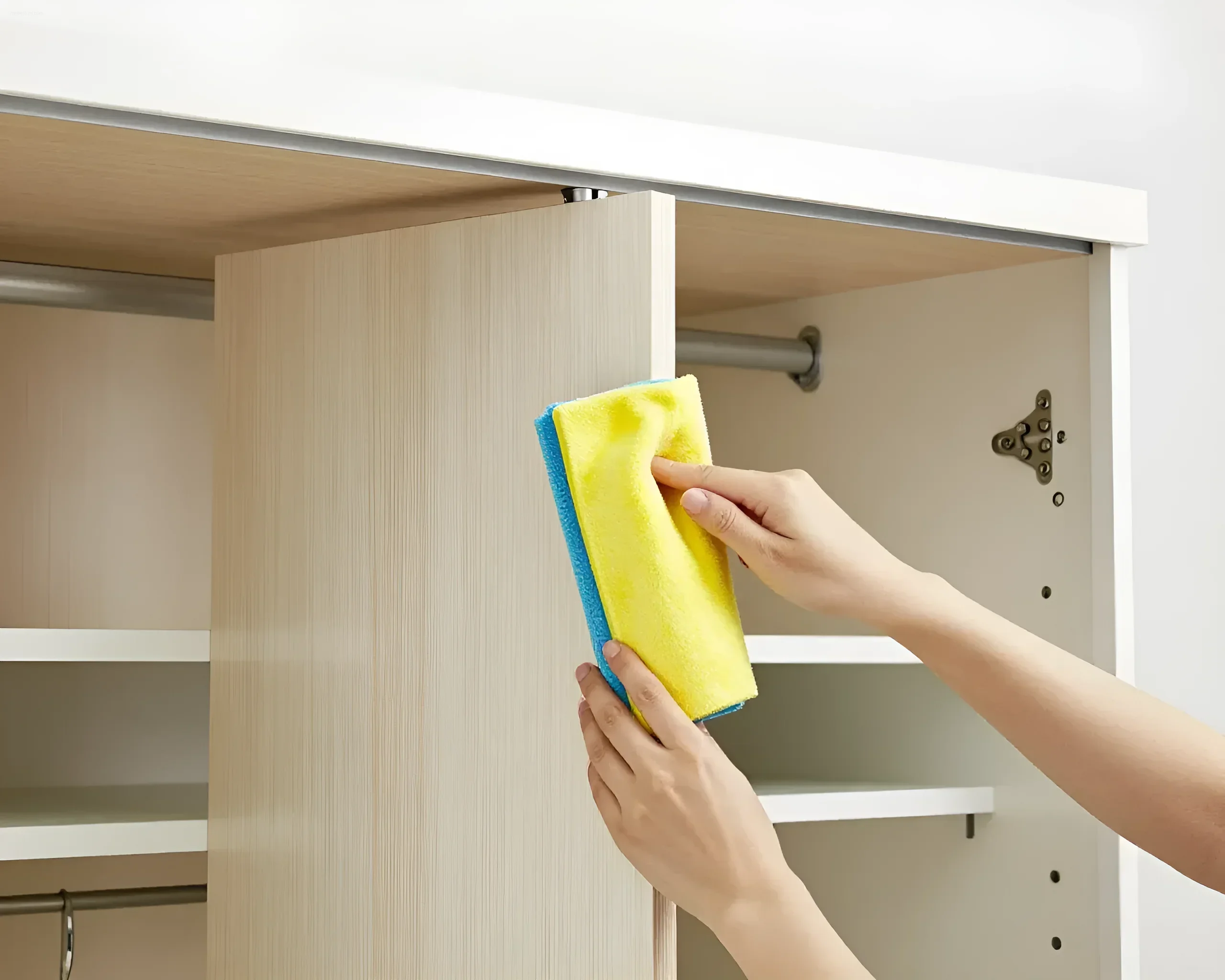
Even the highest quality wardrobe requires care. To ensure the mechanisms last 15–20 years, follow these simple rules:
Cleaning the guides. Vacuum the lower track once a month. Hair, pet fur, and small debris wrap around the roller axles, leading to jamming and breakage. If a door becomes stiff to move, check the track first.
Mirror care. Do not use ammonia-containing products to clean mirrors with amalgam, as this can cause dark spots to appear around the edges. It is better to use special glass cleaners and a soft microfiber cloth.
Door adjustment. Over time, due to house settling or temperature fluctuations, doors can become crooked. At the bottom of the side profile, there is usually an adjustment screw for a hex key. By turning it, you can raise or lower the edge of the door so that it fits snugly against the side.
Careful handling of LDSP. Avoid getting water on the board joints (edging). Despite the moisture resistance of the lamination, with constant contact with water, the particleboard can swell.
Top 5 Popular Sliding Wardrobe Models: Review of the Best Solutions
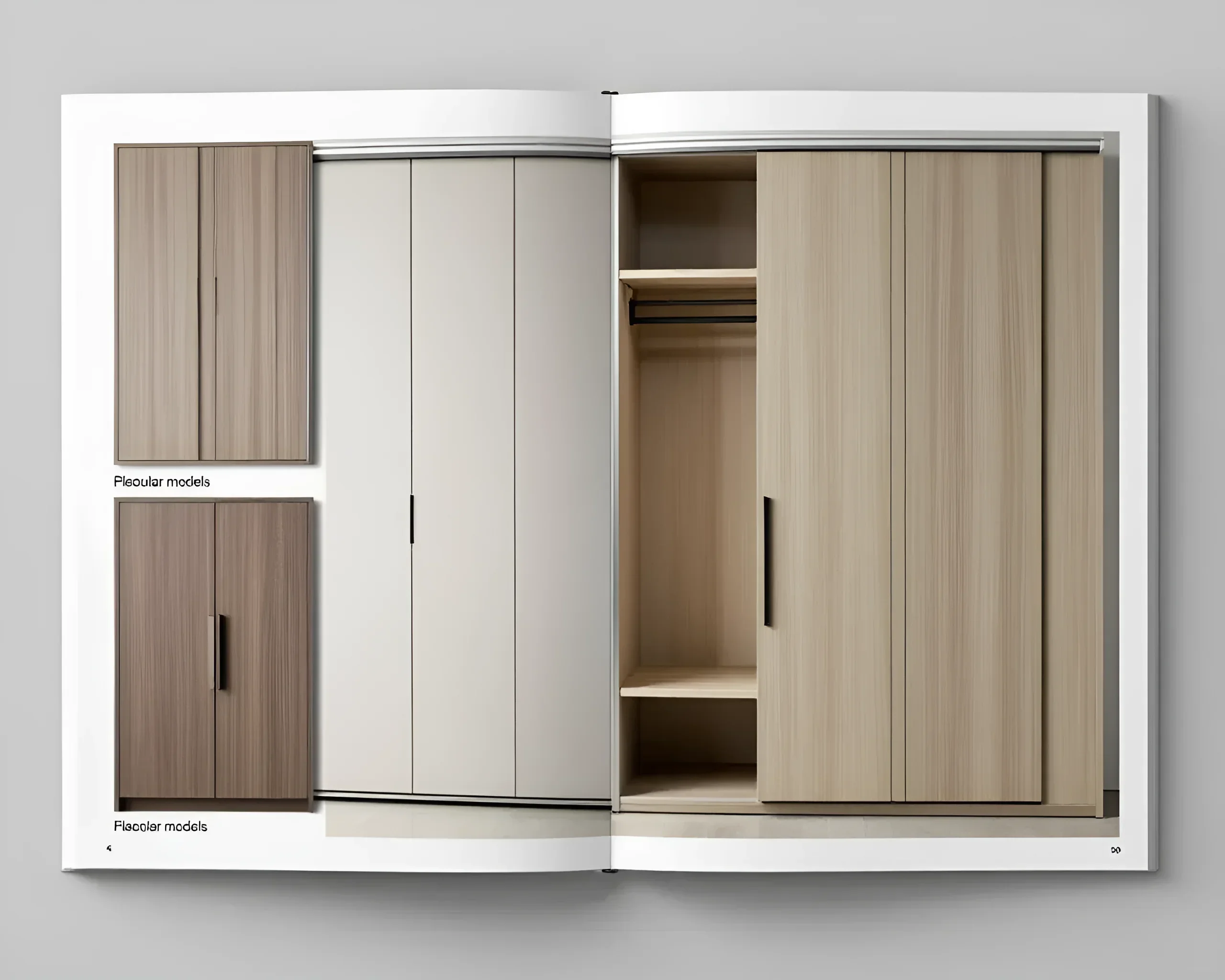
Certain configuration standards have emerged in the market that suit most buyers. Let’s consider the most successful options:
- “Classic Three-Door” (width 210–240 cm). Ideal balance. The central door is usually mirrored, the side ones are solid. Inside: one section with shelves, one with rods, and one combined.
- “Compact Two-Door” (width 120–160 cm). The best solution for an entryway. One section for outerwear, the second for shoes and accessories. Often equipped with external corner shelves (consoles) for keys.
- “Corner Master” (L-shaped). Allows you to utilize the “dead zone” in the corner of the room. A rod for seasonal clothing that doesn’t require daily access is usually placed in the corner itself.
- “Built-in Minimalist” (wall-to-wall). Facades made of frosted glass or in the color of the walls. Creates the effect of a monolithic wall without overloading the interior. Maximum storage volume.
- “Radius Luxe”. A model with curved facades. Placed at the end of a corridor or in spacious bedrooms. It is more of a design object that softens sharp corners in the room.
Frequently Asked Questions About Choosing a Sliding Wardrobe (FAQ)
Question: Which door system is better – supported or suspended?
Answer: The supported (bottom) system is more reliable for heavy doors and easier to install. The suspended system looks more aesthetic (no bottom profile) but requires a perfectly even and strong ceiling.
Question: Should I install soft-close mechanisms on sliding doors?
Answer: Highly recommended. A soft-close mechanism smoothly brings the door to the side, preventing strong impacts that loosen the frame and can damage the mirror. This significantly extends the life of the hardware.
Question: Can a sliding wardrobe be installed if the room has a stretch ceiling?
Answer: Yes, but you need to think about it in advance. Either a wooden beam is installed under the ceiling fabric to which the track is attached, or the wardrobe is made with a roof (freestanding), and a small gap is left between it and the ceiling.
Question: How to calculate the number of doors?
Answer: The number of doors should correspond to the number of vertical sections inside the wardrobe. If you have 3 sections, make 3 doors. This will ensure convenient access to any part of the filling.
Interesting Facts About Sliding Wardrobes
- The prototype of the modern sliding wardrobe is considered to be the screens used by Napoleon Bonaparte’s officers during campaigns to hide the mess in their tents.
- The first steel systems for sliding doors in their current form appeared in the USA in the mid-20th century, and they only gained mass popularity in Europe in the 70s.
- The longest sliding wardrobe in the world was custom-made and was over 50 meters long, occupying an entire corridor in an office building.
- Mirrored sliding wardrobe doors can increase the room’s illumination level by 20-30% by reflecting natural light from windows.
Choosing a sliding wardrobe is a balance between your budget, the technical capabilities of the room, and aesthetic preferences. Do not skimp on the profile and rollers – these are the details that determine whether your wardrobe will delight you with smooth door movement or become a source of daily irritation. We hope our guide will help you make the right choice and organize the perfect storage system in your home!