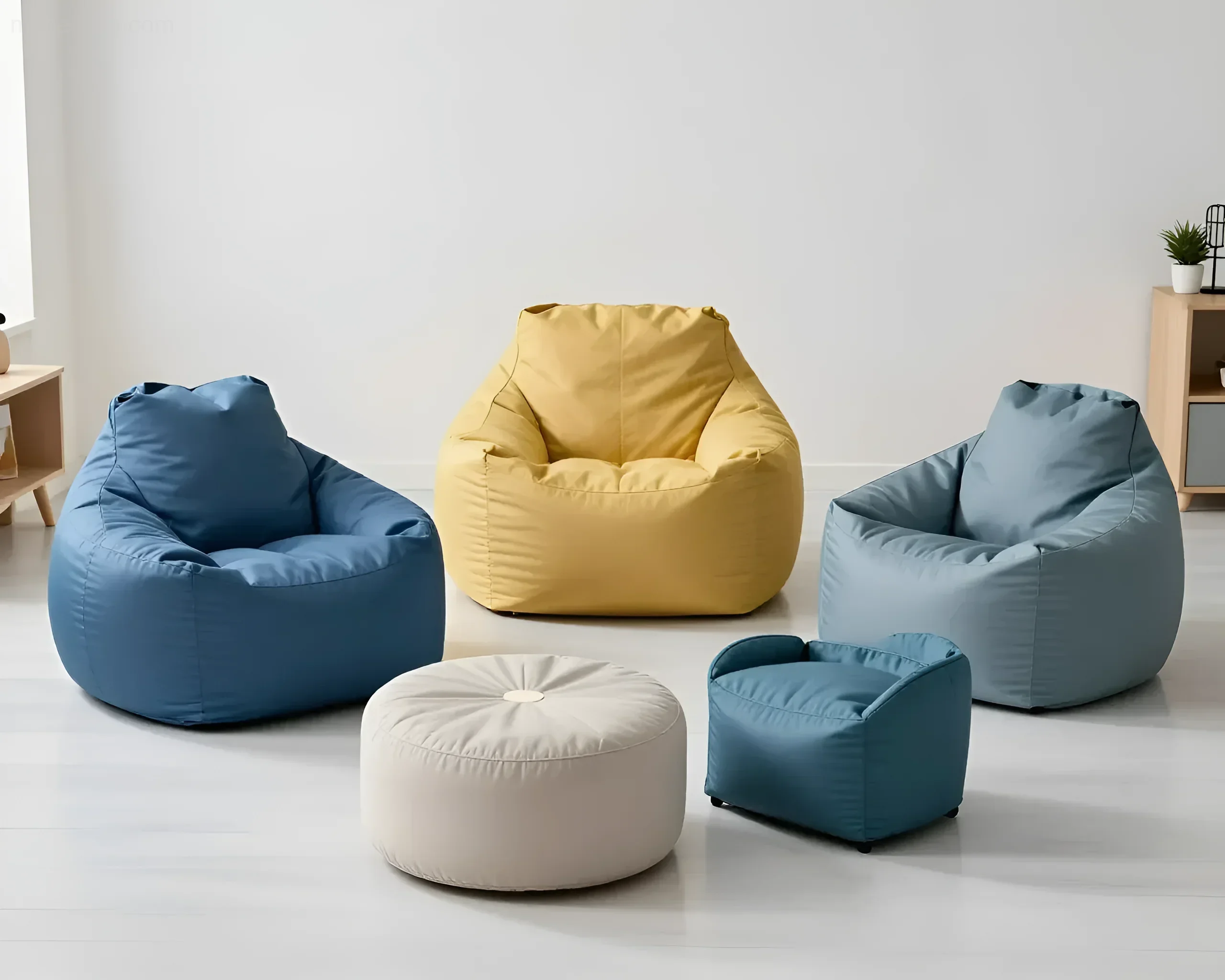
Furnishing a child’s room is always a search for a balance between aesthetics, functionality, and, above all, safety. A pouf in a child’s room has long ceased to be just an extra seat; today it is also a soft construction set, a treasure chest, and a safe island for games. Unlike bulky armchairs, poufs are mobile, have no sharp corners, and allow the child to organize their own space. In this guide, we will delve into what to look for when buying so that the pouf lasts a long time and playing with it is absolutely safe for your baby’s health.
Children’s Poufs: Types and Varieties for Little Fidgets
The children’s furniture market offers a huge variety of designs. To avoid confusion, it’s worth dividing them into several main categories, each with its own operational features.
- Frameless Poufs (Bean Bags): These are classic “beanbags” or “pears.” They have no rigid base and take the shape of the child’s body. This is the safest option for active games, as they completely lack hard elements.
- Framed Poufs: Have a rigid base made of plywood, particleboard, or wood, covered with soft filler and fabric. They are more stable and often equipped with an internal drawer for storing toys.
- Animal Poufs: Themed models in the shape of elephants, hippos, sheep, or dinosaurs. They usually have a wooden frame and soft upholstery. They serve not only as furniture but also as a full-fledged toy.
- Modular Poufs: Sets of several soft elements (cubes, cylinders) that can be assembled into different shapes. Ideal for developing fine motor skills and creative thinking.
- Inflatable Poufs: A budget-friendly and mobile option. They are easy to clean and can be taken to the dacha, but they are less durable and sensitive to punctures.
The choice of construction type directly depends on the child’s age. For toddlers up to 3 years old, it’s better to choose frameless models, while schoolchildren might suit more rigid framed options with an orthopedic effect.
Safe Materials for Children’s Poufs: Choosing the Best for Your Child
When it comes to children’s furniture, the composition of materials is paramount. A child spends a lot of time on the pouf, comes into contact with it with their skin, and sometimes even tastes it. Therefore, mebeltops.com experts recommend paying attention to the following characteristics.
1. Upholstery Materials (Outer Cover):
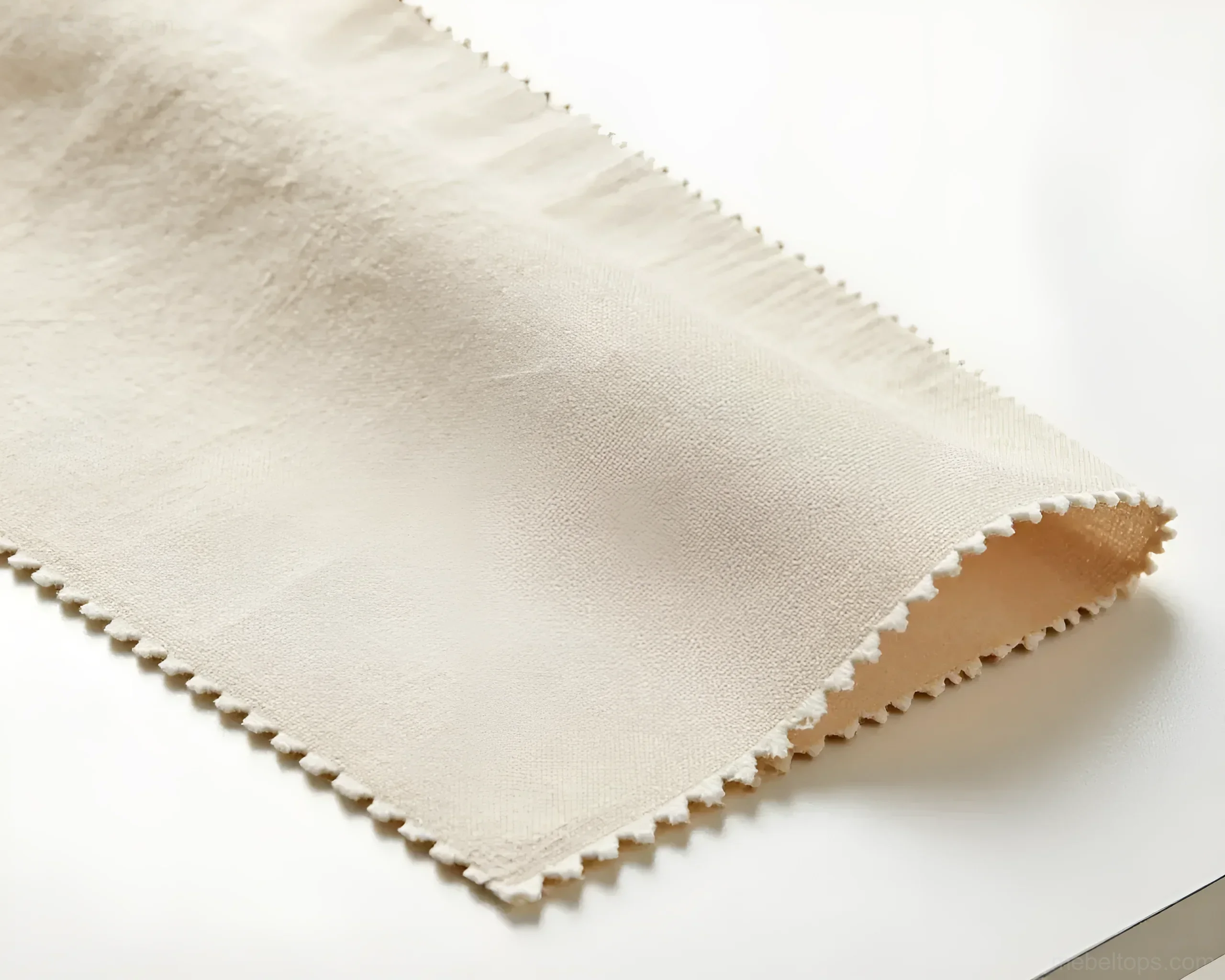
- Oxford: Durable synthetic fabric with a special “matting” weave. It is wear-resistant, water-repellent, and easy to clean with a damp sponge. Ideal for active children.
- Microvelour and Corduroy: Pleasant to the touch, create coziness. Modern types of microvelour have an “anti-claw” effect and high resistance to abrasion (from 20,000 to 50,000 Martindale cycles).
- Eco-leather: Easy to clean, but can be “cold” to the touch. For a child’s room, it’s better to choose perforated eco-leather that “breathes.”
- Cotton and Linen: Eco-friendly, hypoallergenic, but get dirty and wear out quickly. Recommended only in the form of removable covers that can be washed frequently.
2. Fillers:
- Expanded Polystyrene Foam (EPS): Small balls with a diameter of 2-4 mm. This is the main filler for frameless furniture. It is important that the balls are primary processed (they smell less and shrink less over time).
- Polyurethane Foam (PUF): Used in framed models. Choose a density of at least 25-30 kg/m³ so that the pouf does not sag after a month of use.
- Holofiber: Often added to polystyrene foam to give the pouf extra softness and elasticity.
3. Frame (for rigid models):
If you are choosing a framed pouf, make sure it is made from materials of emission class E0 or E1. This guarantees minimal formaldehyde emission. The best choice is birch plywood or solid wood.
How to Choose the Perfect Pouf for a Child’s Room: Practical Tips
When buying a pouf, it’s not enough to just look at its appearance. A professional approach requires checking several critical construction nodes.
- Double Cover: This is mandatory for frameless models. The outer cover should be easily removable for washing, and the inner cover should securely hold the filler.
- Zipper Protection: The zipper pull should be hidden in a special pocket or have a locking system so that the child cannot open the pouf themselves and spill the filler. Polystyrene beads are extremely dangerous if inhaled!
- Air Vents: Frameless models should have special holes with metal rings (eyelets). They allow air to escape quickly when sitting down, which prevents the fabric from tearing along the seams.
- Seam Quality: Double reinforced seams are mandatory for children’s furniture. The threads should be polyester or nylon – they do not rot and can withstand huge tensile loads.
- Product Weight: A good pouf for a child should be light (up to 3-5 kg) so that the child can move it themselves without risking dropping it on their foot.
Expert Tip: When choosing a pouf in a store, try to sit on it sharply. If you hear a characteristic crackling sound or feel air struggling to escape the cover – such a model will not last long.
Sizes and Dimensions of Children’s Poufs: Finding the Optimal Solution
The size of the pouf should correspond to the child’s height and the room’s area. Too large a pouf will clutter the space, and too small a one will be uncomfortable to sit on.
Standard size chart for frameless poufs (pears):
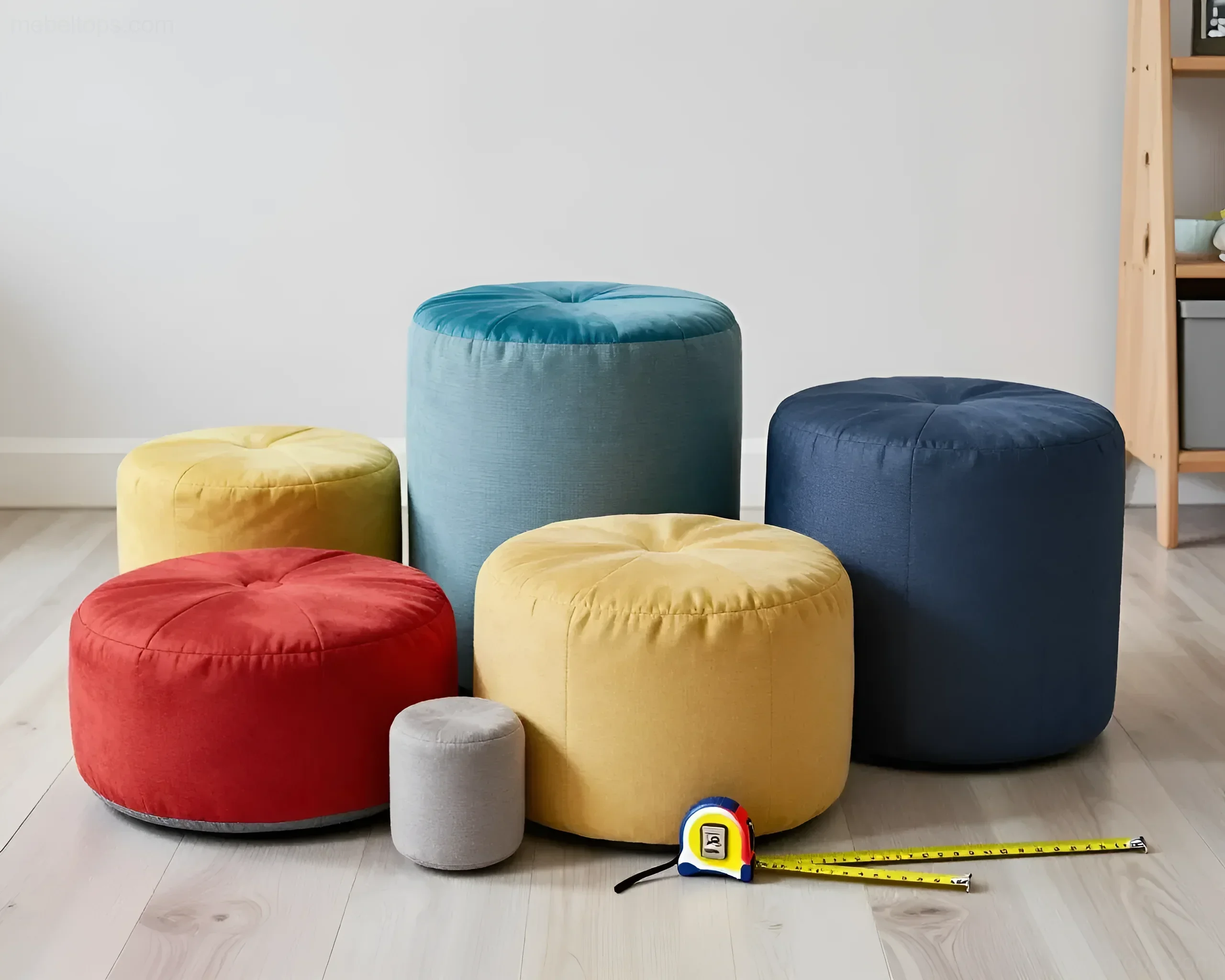
- Size S (diameter 60-70 cm, height 80-90 cm): Ideal for toddlers up to 110 cm tall. Takes up minimal space.
- Size M (diameter 80-90 cm, height 110-120 cm): A universal option for preschool and early school-aged children (up to 150 cm tall).
- Size L/XL (diameter from 100 cm): Suitable for teenagers and even adults. May look excessive in a small nursery.
For framed poufs, focus on seat height:
- For children aged 2-4: height 25-30 cm.
- For children aged 5-7: height 30-35 cm.
- For schoolchildren: standard height 40-45 cm.
Remember that when sitting on a pouf, the child’s legs should not hang in the air, and their knees should not be raised too high above hip level, unless it is a frameless model that allows for a semi-reclining position.
Functionality of Children’s Poufs: Storage and Transformation
A modern pouf is a multifunctional piece of furniture. In typical apartments where every square meter counts, additional functions become a decisive factor in choice.
Poufs with Storage System:
Framed models often have a flip-up lid or a removable seat, under which a niche is hidden. The volume of such storage can vary from 10 to 40 liters. This is an ideal place for:
- Construction sets and small toys;
- Bedding or blankets;
- Seasonal clothing.
Transformer Poufs:
There are models consisting of several interconnected segments. When unfolded, such a pouf turns into a soft play mat or even a temporary sleeping place for a friend who stayed too late. Also popular are “5-in-1” poufs, where four smaller stools are hidden inside one large cube – a great solution for children’s parties.
Developmental Function:
Poufs in the shape of cubes with letters, numbers, or different types of fasteners (busy poufs) help the child develop through play. This is a great example of how furniture becomes part of the educational environment.
Caring for Children’s Poufs: How to Maintain Cleanliness and Freshness
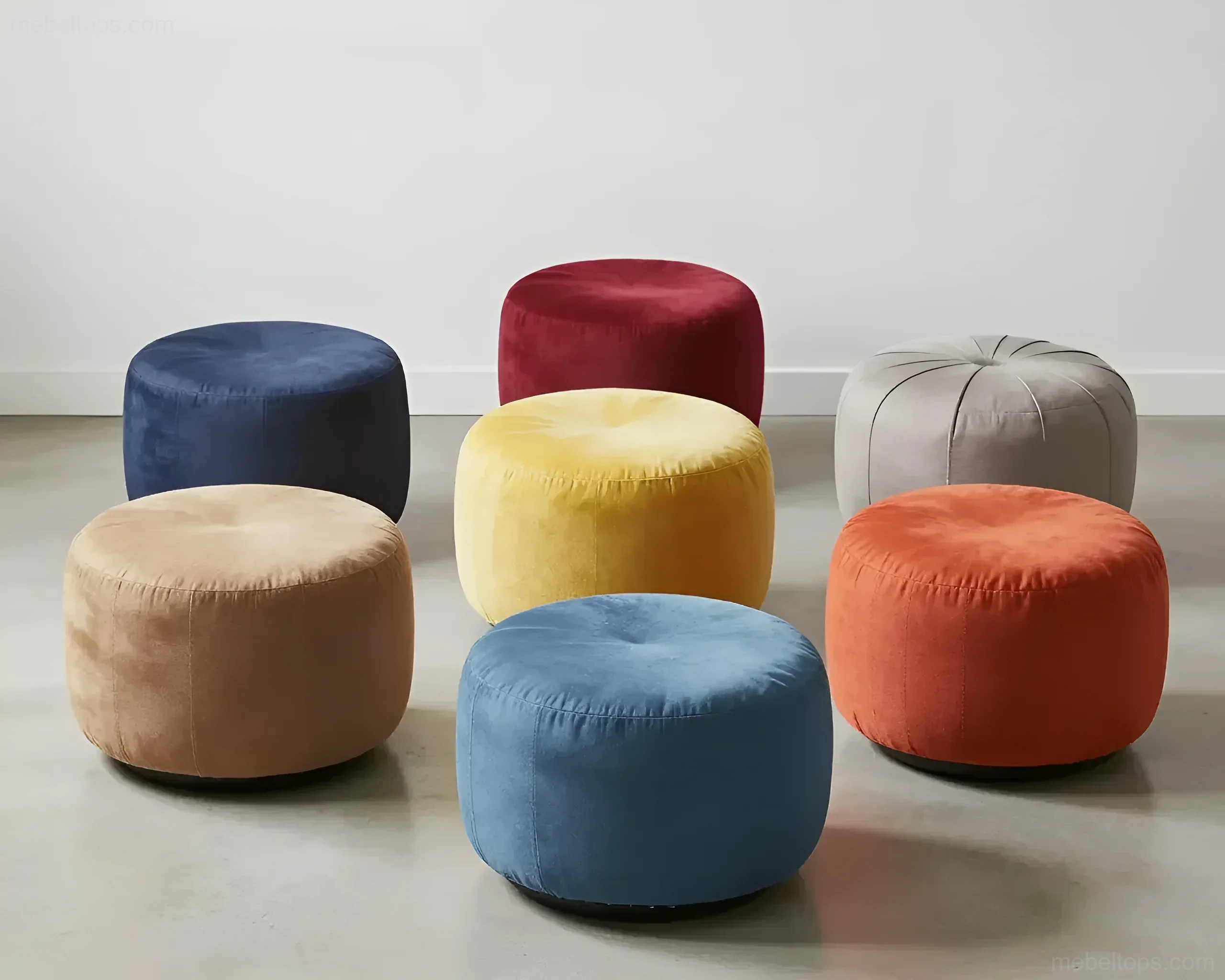
A child’s room is a high-risk zone for furniture. Spilled juice, marks from felt-tip pens and plasticine are common occurrences. Proper care will help extend the life of the pouf for many years.
Cleaning Recommendations:
- Removable Covers: Wash them on a delicate cycle at a temperature not exceeding 30-40 degrees Celsius. Use children’s hypoallergenic detergents. Do not use harsh bleaches, as they can destroy the fabric structure and make it less durable.
- Dry Cleaning: For plush fabrics (velour, chenille), use a vacuum cleaner with a soft brush attachment once a week. This will prevent dust from accumulating within the fibers.
- Stain Removal: Fresh stains from juice or food are best removed immediately with soapy water. Greasy stains can be carefully blotted with a napkin with a small amount of dish soap.
- Adding Filler: Polystyrene foam in frameless poufs tends to settle (by 10-20% per year, depending on the intensity of use). Every year or year and a half, it is necessary to buy a bag of filler and add it to the inner cover.
Important: When adding filler, do so in the absence of children and pets. The beads are very light, become electrostatically charged, and instantly scatter throughout the room.
Top 5 Safe and Stylish Poufs for a Child’s Room
Based on customer reviews and technical specifications, we have compiled a list of the most successful models for children’s rooms.
- Classic Oxford fabric pear chair: The most practical choice. It is moisture-resistant, easy to move, and inexpensive. Suitable for children from 3 years old.
- Hippo pouf (or other animal) on wooden legs: Will become the baby’s favorite friend. Choose models upholstered in microvelour – they are the softest and most durable.
- Knitted pouf (knitted matting): A very stylish interior element. Usually has a dense inner cover with polystyrene foam. Ideal for a Scandinavian-style nursery.
- Square pouf with toy storage: Combines a seating area and a storage system. It is important to have gas lifts or soft stoppers so that the lid does not pinch the child’s fingers.
- Modular transformer pouf: A set of soft mats that fold into a cube. The best option for active games and building “forts.”
Frequently Asked Questions About Children’s Poufs: Expert Answers from mebeltops.com
From what age can a child have a pouf?
Frameless models (beanbags) are safe from 1.5-2 years old, when the child sits confidently and begins to move actively. Framed models with sharp corners (if any) are better postponed until 3-4 years old.
Is polystyrene foam filler safe?
Yes, it is a chemically neutral material that does not emit harmful substances and is not a breeding ground for bacteria or dust mites. The main danger is the possibility of swallowing the beads, so a high-quality inner cover is mandatory.
What is the most durable fabric for a child’s room?
For an “indestructible” pouf, choose Oxford with a density of 600D. If tactile comfort is important, then microvelour with a Martindale test rating above 30,000 cycles.
Can a pouf be used as the main place for activities?
No, for writing or drawing at a desk, a chair with a firm back is necessary for proper posture formation. A pouf is intended only for rest, reading books, and playing.
How to tell if a pouf is of good quality right in the store?
Check three things: the absence of a sharp chemical odor, the presence of an inner cover, and the quality of the hardware (the zipper should move smoothly, threads should not be sticking out).
Choosing a pouf for a child’s room is an investment in your child’s comfort and joy. By following our advice, you can choose a model that will be not only beautiful but also absolutely safe, functional, and easy to care for. Remember that there are no trifles in children’s furniture!