Русский
 Deutsch
 Українська

Shelving and shelves are not just storage structures, but key elements that define the functionality and aesthetics of any room. A well-chosen storage system can not only accommodate everything you need but also visually correct the space, adding character and order. As professional experts from mebeltops.com, we have prepared a maximally detailed and practical guide for you to navigate the variety of materials, types, and sizes, ensuring your choice is informed and long-lasting.
Shelving and Shelves: Types for Any Interior
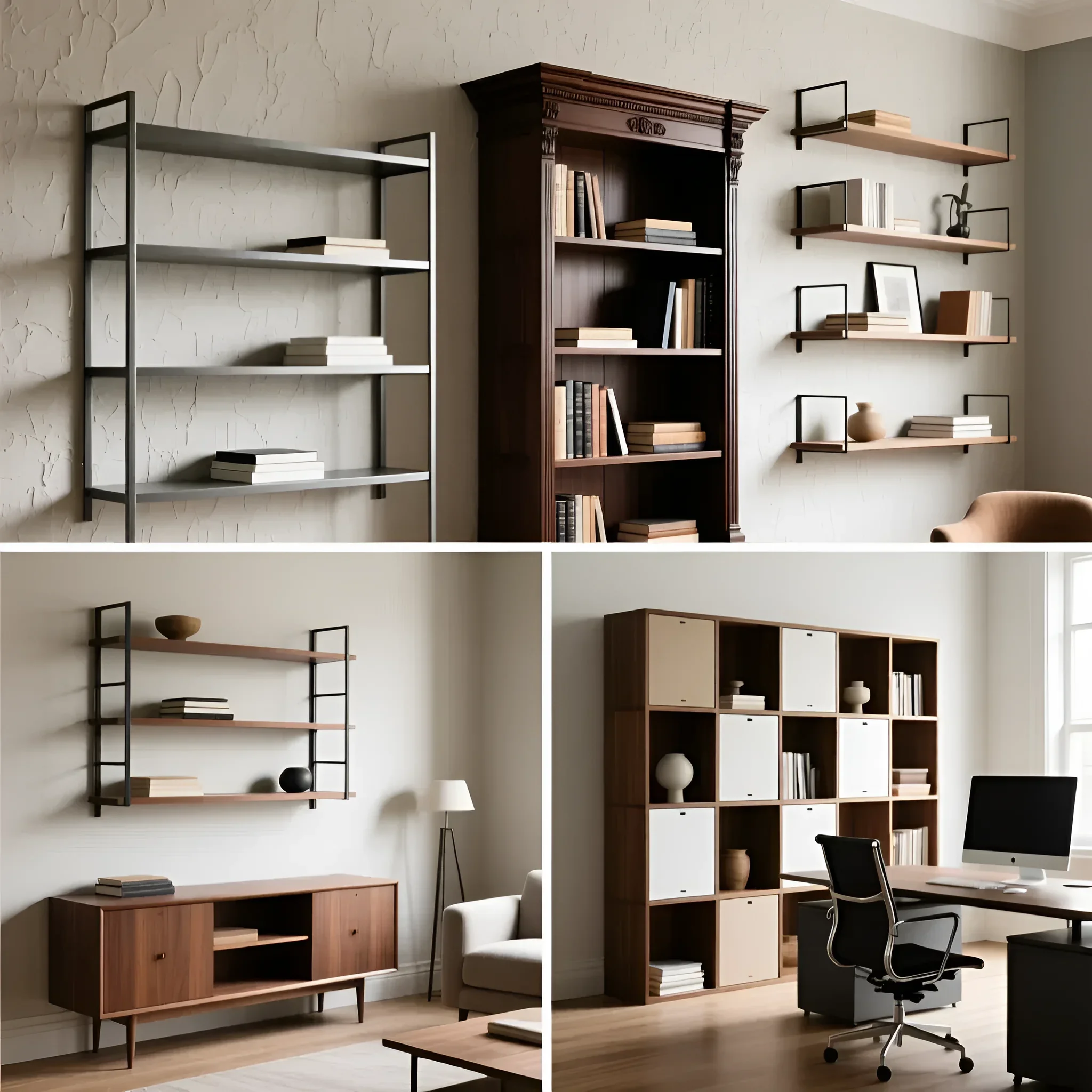
Before choosing, it’s essential to clearly define the role the storage system should play: decorative, zoning, or purely practical (for heavy items). The variety of designs allows for a solution for any task.
Types of Shelving Units by Construction
- Classic Wall-Mounted (Closed or Open): The most common type. Designed for installation along walls. Depth usually varies from 25 to 45 cm. Excellent for libraries, offices, or living rooms.
- Zoning (Through-Type): Have no back panel. Ideal for dividing studios or large rooms into functional zones (e.g., a workspace and a relaxation area). Important: for stability, they require secure fastening to the floor or wall if the height exceeds 180 cm.
- Modular (Cubic): Consist of identical sections (cubes) that can be combined horizontally and vertically. A popular example is the “Kallax” type system. Advantage: high adaptability and the ability to add inserts, drawers, or doors. Standard cube size: 33×33 cm or 38×38 cm.
- Ladder (Stepped): Have sections of different heights, allowing for efficient use of space under sloping roofs or attics, and also serve as an interesting decorative element.
- Cantilever (Wall-Mounted): A system where shelves are attached to vertical rails, which are in turn fixed to the wall. Often used in wardrobes or pantries as they provide high flexibility in shelf height adjustment.
Types of Shelves by Mounting Method
Shelves, unlike shelving units, are a lighter and more flexible solution but have strict load limits.
- Wall-Mounted (Cantilever): The simplest type. Attached directly to the wall. It’s important to consider the wall material and the type of fasteners. For concrete, anchor bolts are suitable; for drywall, special butterfly or Molly anchors are needed.
- Shelves with Hidden Fasteners: Create a “floating” shelf effect. Metal pins are used for mounting, which are embedded into the shelf’s thickness. They require a material thickness of at least 25 mm for reliability and can support less load (usually up to 10–15 kg per meter of length).
- Built-in Shelves (Niches): Created during room planning. They provide maximum visual clarity as they do not protrude beyond the wall plane.
Materials for Shelving Units and Shelves: From Chipboard to Solid Wood

The choice of material directly determines the durability, appearance, and, critically, the maximum load your storage system can bear. Price, strength, and maintenance requirements vary enormously.
1. Wood-Based Panel Materials (Chipboard and MDF)
This is the most popular and budget-friendly segment. Ideal for most household needs.
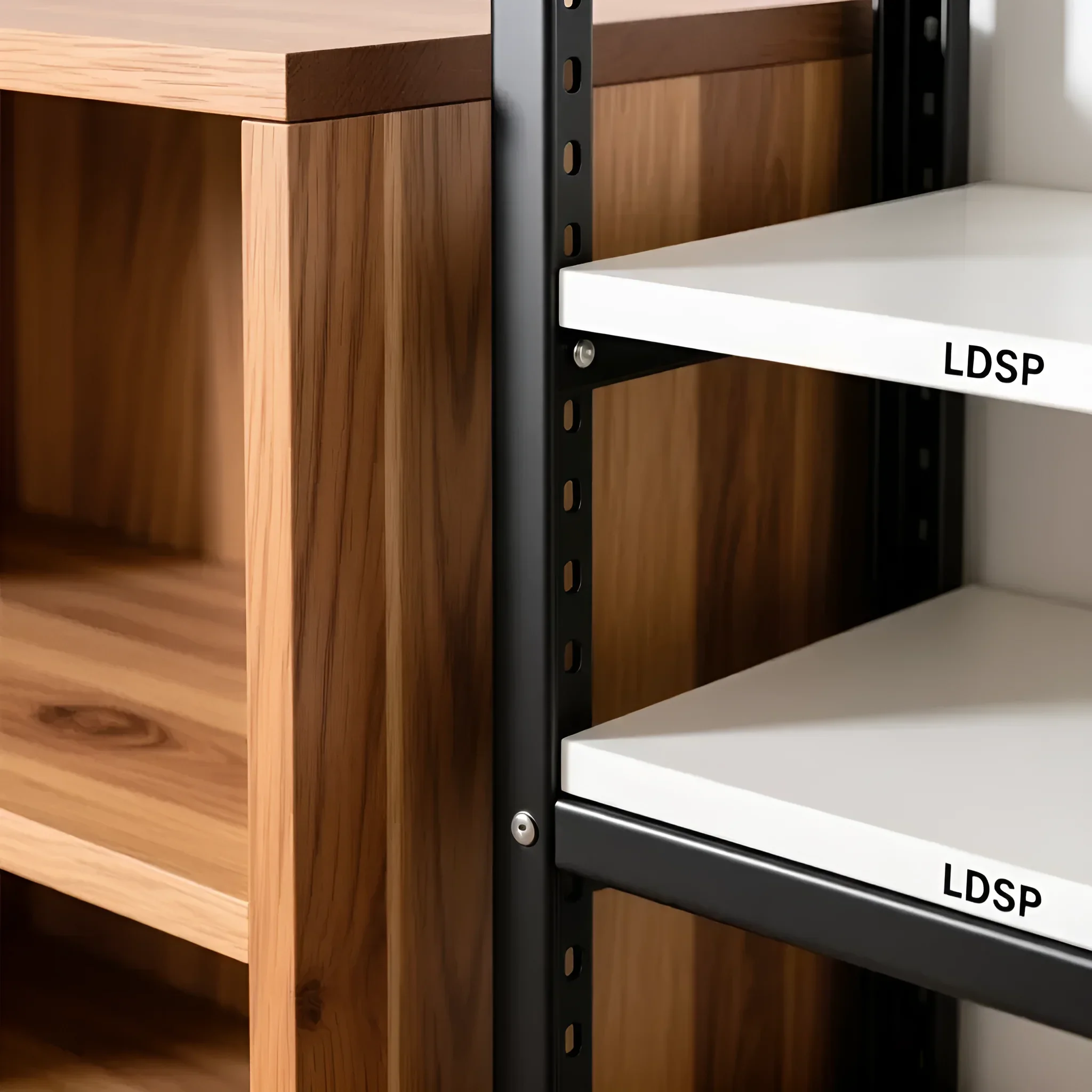
- Chipboard (Laminated Particleboard): An economical choice. Standard thickness for shelving units is 16 mm or 18 mm. Technical specifications: Density is usually 650–700 kg/m³. It is crucial to pay attention to the formaldehyde emission class. Choose class E1 (European standard) or, even better, E0.5.
- MDF (Medium-Density Fibreboard): Denser and more environmentally friendly than chipboard (density 720–850 kg/m³). MDF is better for milling, allowing for the creation of shaped facades or edges. Often used for open shelves where the aesthetics of the cut and edge are important.
- Price: Chipboard is 30–50% cheaper than MDF.
- Service life: With proper use (avoiding moisture and edge damage) – 10–15 years.
2. Solid Wood
A premium and most durable option. The choice of wood species affects strength and price.
- Oak and Beech: Possess maximum strength and resistance to sagging. Ideal for heavy libraries. Require periodic oil or wax treatment.
- Pine and Spruce: Softer and lighter woods, more affordable. Suitable for decorative storage or light items. Their strength is lower, so pine shelves of significant length (over 80 cm) and load require additional support.
- Humidity: Solid wood is sensitive to humidity fluctuations. The optimal room humidity level is 40–60%.
3. Metal and Glass
Used for creating modern interiors (Loft, High-tech) or for systems with extremely high loads (garages, archives).
- Metal Shelving Units: Frames are made from steel profiles (thickness from 1.5 mm). Shelves can be metal, mesh, or plywood. Load capacity: Industrial models can support up to 300 kg per section, domestic models – 50–150 kg per shelf.
- Glass Shelves: Used mainly for decor, dishes, or bathrooms. Required glass thickness for safe operation: 6–8 mm for light shelves (up to 5 kg load) and 10–12 mm for heavier items. The glass must be tempered.
| Material | Strength/Load Capacity | Moisture Resistance | Price Segment |
|---|---|---|---|
| Chipboard (16 mm) | Medium (prone to sagging at lengths > 80 cm) | Low (critical to edges) | Low |
| MDF (18 mm) | Above average | Medium (better than chipboard) | Medium |
| Solid Wood (Oak/Beech) | High (excellent rigidity) | Medium (requires maintenance) | High |
| Metal (2 mm Profile) | Maximum | High (with powder coating) | Medium/High |
How to Choose the Ideal Shelving Unit: Assessing Functionality and Style
Choosing the ideal storage system begins with analyzing exactly what you plan to store and in which room. Incorrect use leads to overloading, shelf sagging, and rapid wear.
Step 1: Determining Purpose and Load Capacity
- Books and Archives: If you store heavy volumes, you need shelving units made of solid wood or thick (25 mm) MDF/chipboard, or metal structures. Depth should be 20–25 cm.
- Decor and Collections: If the load is minimal (up to 5 kg per shelf), you can use thin glass or cantilever shelves with hidden fasteners. Aesthetics are more important here.
- Wardrobe Systems: Require a depth of 40–55 cm (for folded items or hangers). Metal or modular shelving units are often used for flexibility.
- Kitchen or Garage Storage: Materials resistant to temperature and humidity fluctuations are needed (stainless steel, chrome-plated metal).
Step 2: Integration into Interior Style
The shelving unit should match the overall style of the room.
- Loft: Open metal shelving units with shelves made of rough solid wood or dark chipboard. Characterized by black matte frames and minimalist design.
- Scandinavian Style (Scandi): Light, bright structures. White chipboard or light solid wood (pine, birch) is often used, combining open shelves with closed drawers or baskets. Modular systems prevail.
- Classic/Neoclassic: Shelving units made of solid wood or MDF with milling, often with partial glazing and a plinth. Require greater depth and height.
- Minimalism: Involves using shelves with hidden fasteners or through-type shelving units without visible handles or unnecessary details to create a “clean lines” effect.
Step 3: Checking Stability and Fastening
If the shelving unit is taller than 150 cm, it must be attached to the wall, especially in homes with children or pets. Use corner brackets or cables. Never rely solely on the weight of the structure, especially if it is narrow (depth less than 30 cm).
Optimal Sizes and Dimensions: Calculations for Maximum Capacity
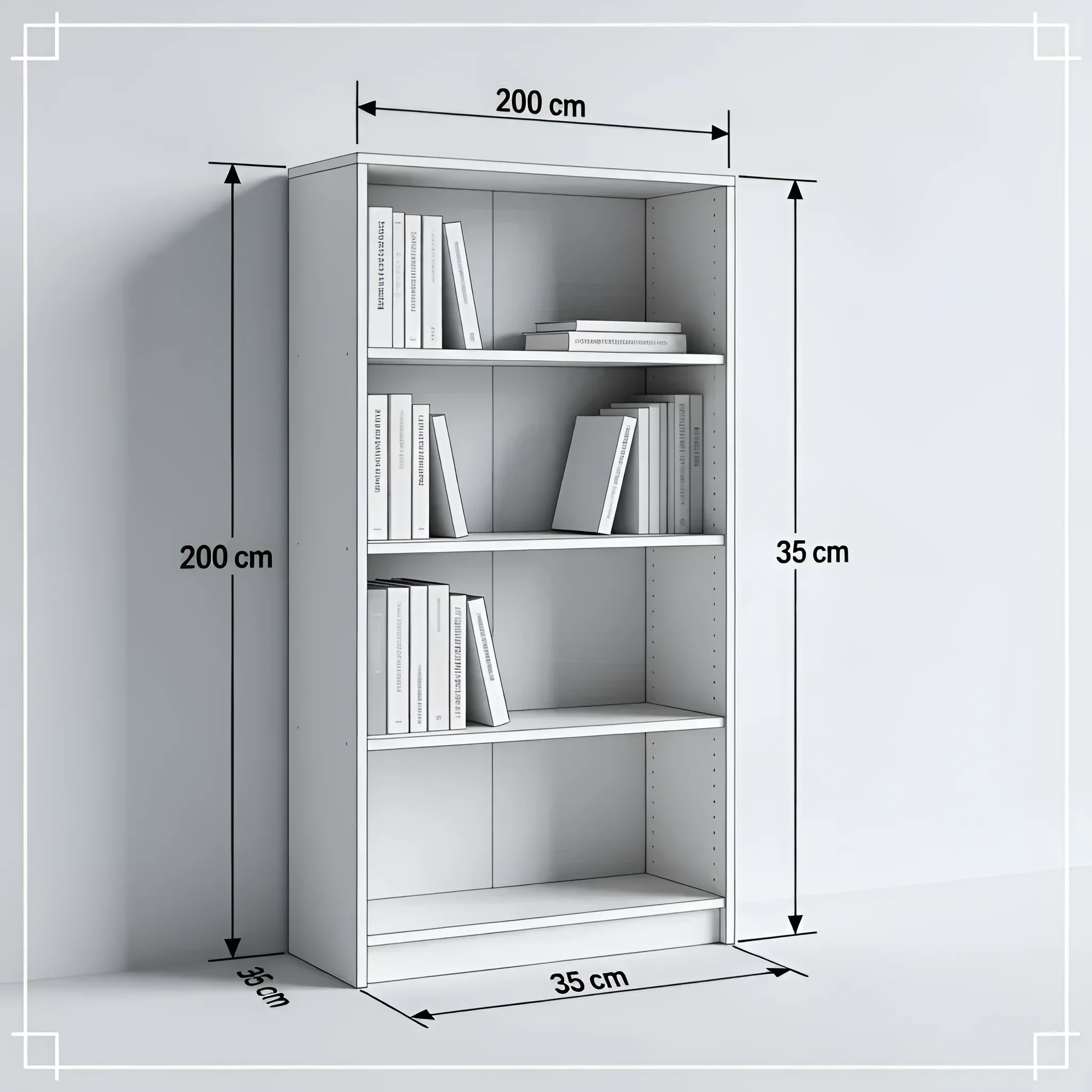
Correct dimensions are key to ensuring the shelving unit is not only beautiful but also functional. An error in shelf depth or height can make the storage system useless.
Optimal Depth of Shelving Units (D)
The depth should match the stored items to avoid clutter and inefficient use of space.
- For Books (Standard): D = 20–25 cm. This is sufficient for most publications, and the shelving unit will not appear bulky.
- For A4 Folders (Office): D = 30–35 cm. This is the minimum depth for storing standard archive folders or boxes.
- For Clothing and Linens: D = 40–45 cm. Allows for storing stacks of clothes without crushing them.
- For Electronics (TV, Audio): D = 45–60 cm. Required for accommodating equipment, considering ventilation gaps.
Optimal Shelf Height (H)
The standard height between shelves is 30–35 cm. This is a universal size suitable for most books and decorative items.
- Adjustability: The most practical shelving units have the ability to reposition shelves in 32 mm increments (standard furniture manufacturing). This allows adapting the internal space for different needs, such as placing a tall vase or changing the format of a library.
- Lower Compartment: It’s advisable to make it slightly taller (40–45 cm) for storing large boxes or heavy items.
Calculating Shelf Load and Sag
This is the most important technical aspect. Shelf sag (deformation) occurs if the span length (distance between vertical supports) is too large for the shelf’s thickness and material.
Practical rule for chipboard (16 mm):
- If the load is high (books, dishes), the maximum span length should not exceed 60–70 cm.
- If the load is medium (light decor), the span can reach 80–90 cm, but a slight sag may appear over time (no more than 2 mm).
- For spans over 90 cm, chipboard with a thickness of 25 mm, or solid wood/metal, must be used.
Expert tip: If you are buying a ready-made chipboard shelving unit with spans over 85 cm, check if it comes with an additional central support or reinforcement to prevent shelf sagging under weight.
Hidden and Open Storage: Functional Features of Designs

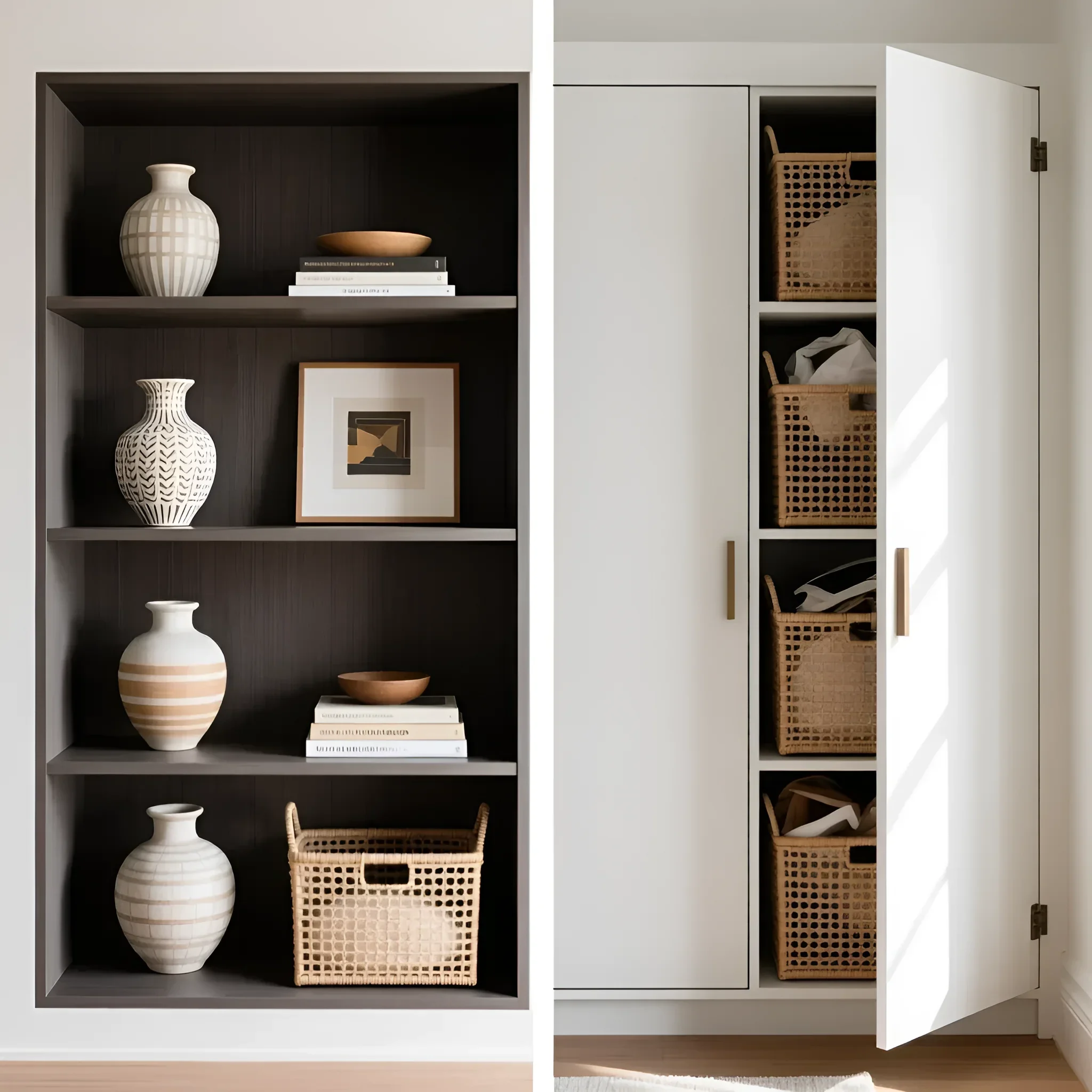
Modern storage systems are rarely completely open or completely closed. A combined approach is more common, achieving a balance between order and accessibility.
Open Storage (Shelves and Through-Type Shelving Units)
Pros:
- Visual Expansion: Open structures do not clutter the space, making the room brighter and larger.
- Accessibility: All items are within reach.
- Decor: Ideal for displaying collections, books, photos, and plants.
Cons:
- Dust: Requires regular cleaning and dusting, as dust accumulates faster.
- Need for Order: Any mess is immediately visible. Requires the use of decorative boxes and baskets for small items.
Hidden Storage (Shelving Units with Doors, Drawers)
Hidden storage provides clean lines and helps hide items that should not be visible (documents, wires, household supplies).
Pros:
- Dust Protection: Items stay clean longer.
- Visual Order: Ideal for minimalist interiors.
- Zoning: Closed shelving units can serve as a full partition.
Cons:
- Bulkiness: Closed facades visually weigh down the structure.
- Additional Costs: Doors, hardware, and opening systems (Push-to-Open or standard hinges) increase the cost of the shelving unit by 30–50%.
Combined Systems (50/50)
The most practical solution. Lower sections (up to eye level, approximately 120 cm) can be made closed for storing clutter, while the upper sections can be left open for decor and books. This maintains a balance between aesthetics and practicality.
Caring for Shelving Units and Shelves: Extending the Lifespan of Your Storage Systems
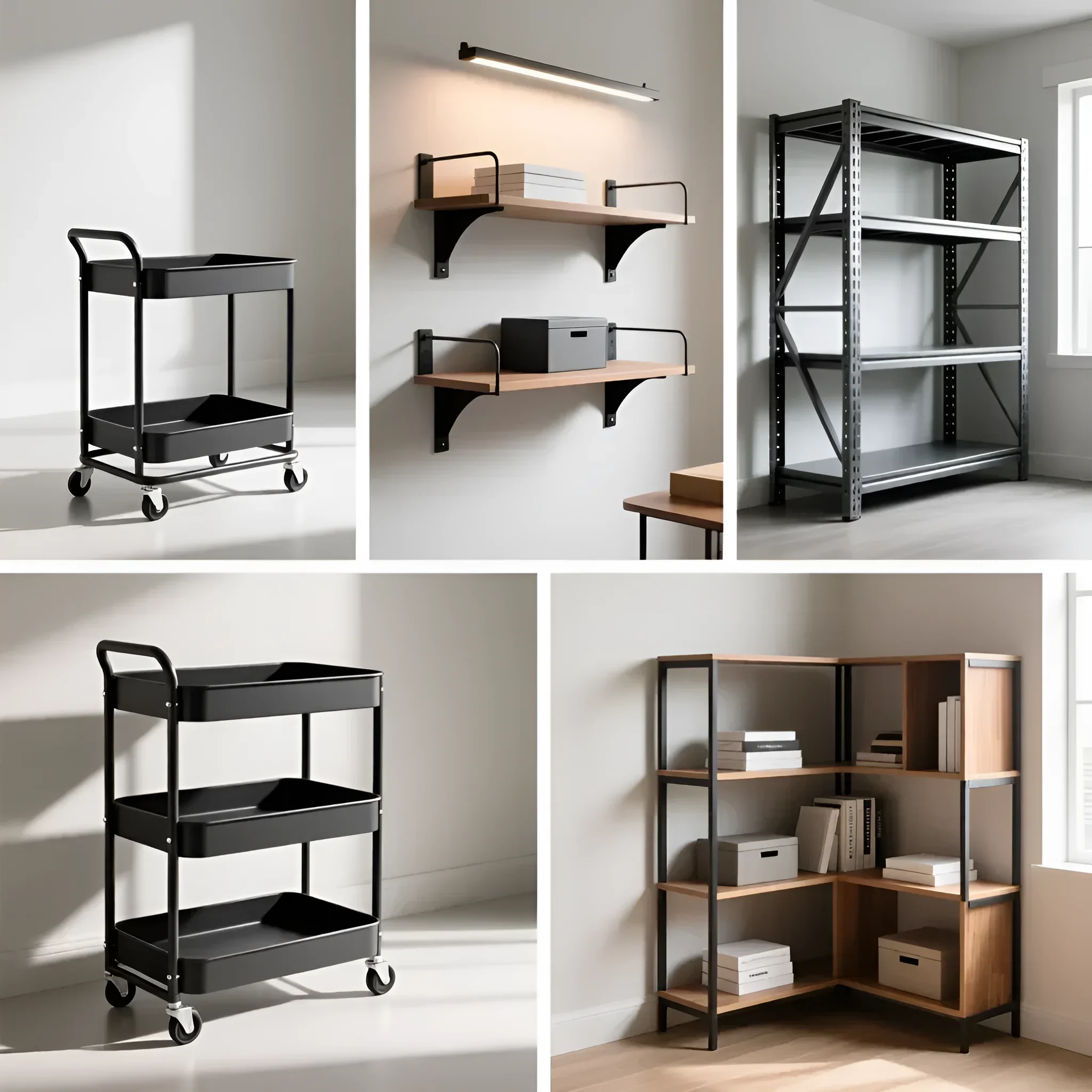
The lifespan of a shelving unit directly depends on proper care and adherence to operating rules. Different materials require different approaches.
Caring for Chipboard and MDF
The main enemy of these materials is moisture. Damage to the edge banding (PVC or melamine) leads to swelling of the board and its deformation.
- Cleaning: Use a soft damp cloth and non-abrasive cleaning agents. Strictly avoid aggressive solvents and powders.
- Edge Banding Check: Periodically inspect the shelf edges. If the edge banding is peeling, it must be re-glued immediately with specialized furniture glue to prevent moisture ingress.
- Protection: Do not place hot or wet items without coasters.
Caring for Solid Wood
Wood requires regular nourishment and protection from drying out.
- Treatment: If the shelving unit is coated with oil or wax, it needs to be renewed every 1–2 years. This will protect the wood from cracks and stains.
- Humidity: Avoid placing wooden shelving units near direct heat sources (radiators, fireplaces), as this can cause deformation and cracking.
- Cleaning: Wipe with a dry or slightly damp soft cloth.
Caring for Metal and Glass Elements
- Metal: If it’s chrome-plated or powder-coated metal, use neutral detergents. Avoid scratches, as damage to the protective layer can lead to corrosion.
- Glass: Use specialized glass cleaners. When placing heavy items (e.g., collectible porcelain), ensure the load is evenly distributed and does not exceed the permissible limit for the glass thickness.
Importance of Even Load Distribution
Never place all the heaviest items in the center of a long shelf. Distribute the weight evenly along its entire length. If the shelving unit has multiple sections, heavy items (e.g., books) are best placed in the lower compartments – this increases the overall stability of the structure.
Top 5 Solutions: The Most Popular and Practical Shelving Unit Models of 2024

The storage system market is constantly evolving, offering new, more adaptable, and stylish solutions. Here are five types of shelving units that remain the most in-demand in 2024 due to their functionality and design.
- Ladder Shelf (Stepped)
Practicality: Ideal for zoning and use in rooms with complex geometry. Provides a smooth transition from floor to wall. Works well as a bookcase and a stand for decor. Available in the range of 5,000 to 15,000 rubles (chipboard). - Modular Cubic System (Kallax/Cube Analogue)
Practicality: Maximum adaptability. Ability to purchase additional sections, insert drawers, doors, change orientation. Standard cube sizes (33×33 cm) are ideal for vinyl records or standard storage boxes. - Loft-Style Metal Shelving Unit (Black Industrial)
Practicality: Combines high load capacity (up to 80 kg per shelf) with minimalist design. Often used in living rooms, studies, and kitchens. Usually has a thin but strong metal frame (20×20 mm or 25×25 mm profile). Range: 10,000 – 30,000 rubles. - Narrow Vertical Shelving Unit (Pencil Case)
Practicality: Solves the storage problem in narrow alcoves (width 40–50 cm). Depth is usually standard (30–35 cm). Ideal for storage in hallways or for creating a vertical library when space is limited. Height often reaches 200–220 cm. - Shelving Unit with Integrated Desk
Practicality: A “two-in-one” solution for small apartments and studios. The shelving unit’s shelves support the desktop, saving space and creating a unified work/study module. Desktop depth is usually 50–60 cm, and shelf depth is 25–30 cm.
Frequently Asked Customer Questions About Choosing Shelving Units and Shelves: A Practical Guide
When choosing storage systems, customers often have the same technical and operational questions. Let’s address the most popular ones.
1. Can a Shelf Be Hung on Drywall?
Answer: Yes, but with weight limitations. Standard drywall (12.5 mm) cannot withstand significant point loads. For light decorative shelves (up to 5 kg), use special “Molly” (umbrella) anchors or butterfly anchors. If a higher load is planned (books, heavy items), you need to find spots where a metal profile runs behind the drywall, or use anchors that reach the load-bearing wall. Ideally, during renovation planning, install backing boards or battens in the shelf mounting locations.
2. What is the Optimal Shelf Thickness for Heavy Books?
Answer: If the span length (distance between supports) is 70–80 cm, we recommend using MDF or chipboard with a thickness of at least 25 mm. If the shelf is made of solid wood, 20 mm is sufficient (for oak/beech). If the span is over 90 cm, you need to either reduce the distance between supports or use a metal frame under the shelf.
3. What is the Main Difference Between Chipboard and MDF When Choosing a Shelving Unit?
Answer: MDF is denser and more resistant to moisture and mechanical damage than chipboard. Chipboard is made from wood chips, while MDF is made from fine wood fibers pressed under high pressure. MDF is preferable for shelves in kitchens or bathrooms, as well as for open shelves where the aesthetics of the cut are important. Chipboard is the optimal choice for economical, closed shelving units in dry rooms.
4. How to Properly Zone a Room with a Through-Type Shelving Unit?
Answer: For effective zoning, the shelving unit should occupy at least 50–60% of the room’s width and be sufficiently tall (from 160 cm). To maintain a sense of light and air, do not fill all the compartments. Leave 30–40% of the compartments empty or use semi-transparent inserts. This allows light to pass through the structure while still separating the zones.
5. Why Does a Shelving Unit Wobble Even When Placed Against a Wall?
Answer: This happens for two reasons. Firstly, an uneven floor (especially relevant for older homes). Always use adjustable feet or levelers. Secondly, lack of wall fastening. If the shelving unit is tall and narrow (e.g., 200×30 cm), its center of gravity is too high. Always use a safety kit (wall attachment). If the shelving unit is modular, ensure all sections are rigidly connected with furniture connectors.
Image Gallery