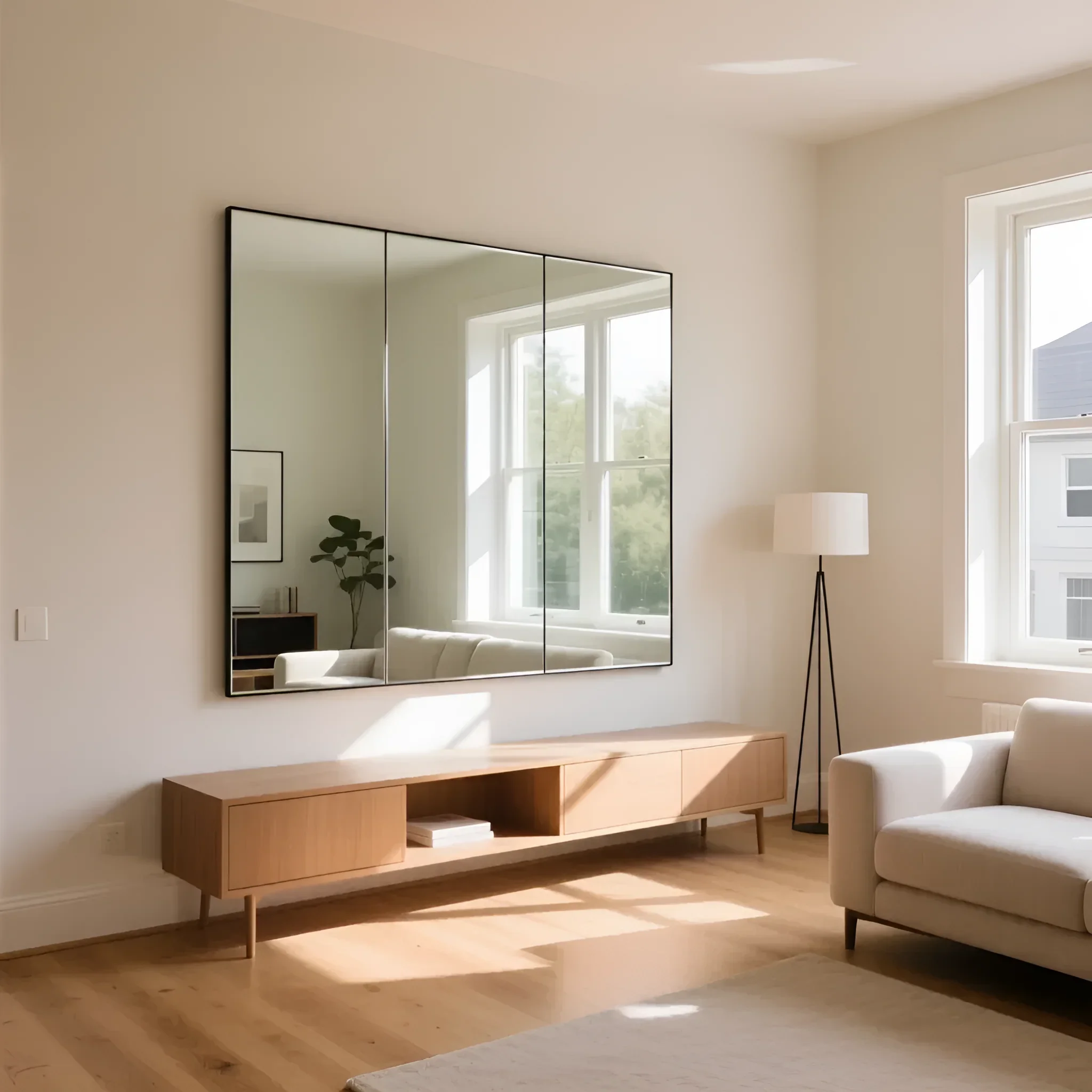
A mirror is not just a functional item for self-checking. In the hands of an experienced designer or a savvy homeowner, it transforms into a powerful architectural tool capable of fundamentally changing the perception of space. Our goal is to show you how, with the help of correctly chosen and strategically placed mirrors, you can not only decorate your interior but also visually double the area of a room, raise ceilings, and multiply the amount of natural light.
For mebeltops.com, we have prepared the most detailed and practical guide to help you choose the perfect mirror based on the technical characteristics of the room and the desired expansion effect.
Types and Styles of Mirrors for Visual Room Enlargement: From Wall-Mounted to Floor-Standing

The effect of space expansion directly depends on the type of reflective surface, its size, and mounting method. The more seamless reflective area, the stronger the illusion of an additional room.
1. Frameless Wall Mirrors (Seamless)
- Characteristics: Extremely flat, with polished or beveled edges, mounted directly to the wall.
- Expansion Benefit: The absence of a frame does not interrupt the reflection, creating the impression that the wall simply continues. Ideal for minimalist and modern interiors.
- Technical Details: When choosing, consider the glass thickness (4–6 mm is optimal) and the quality of the amalgam (silver is preferable to aluminum, as it provides a clearer and more durable reflection).
2. Floor Mirrors (Full-Length or “Psyche”)
- Characteristics: Tall, often 160 cm or more. Can be stationary (leaning against a wall) or on a movable stand (psyche).
- Expansion Benefit: Their height enhances the vertical dimension of the room, visually “lifting” the ceiling. A mirror leaning against the wall at a slight angle (5–10 degrees) not only reflects more space but also makes the reflection more dynamic.
- Optimal Sizes: 180×60 cm or 200×80 cm. Such proportions ensure the capture of a significant part of the interior.
3. Mirror Panels and Tiles
- Characteristics: Composed of many small, often beveled elements, assembled into a unified composition.
- Expansion Benefit: Fragmented reflection (due to beveling) diffuses light, creating a shimmering effect and visual depth. This distracts attention from the actual room boundaries.
- Where to Use: Ideal for narrow corridors or areas where a decorative accent is needed, rather than a clear reflection.
4. Mirrors with Backlighting (LED)
- Characteristics: Integrated LED strip around the perimeter or through frosted areas.
- Expansion Benefit: Backlighting eliminates shadows on the wall, making the mirror appear to “float” and adding an additional source of diffused light, which is critically important for small and dark rooms, especially in hallways and bathrooms.
| Mirror Type | Ideal Placement | Main Expansion Effect | Recommended Budget (Approximate) |
|---|---|---|---|
| Seamless Wall Mirror | Behind the sofa, opposite a window | Maximum continuity and volume | Medium (depends on size and bevel) |
| Full-Length Floor Mirror | Room corner, near the entrance | Increased ceiling height | Medium-High (depends on frame) |
| Mirror Panel | Narrow corridor, accent wall | Decorative depth and light diffusion | High (complexity of installation) |
Proper Mirror Placement: Secrets of Light Reflection and Volume Illusion

The effectiveness of a mirror depends 80% on what it reflects. To create a convincing illusion of additional space, you must carefully consider the reflection point.
1. The Principle of Light Multiplication: Opposite a Window
This is the golden rule. By placing a mirror on a wall perpendicular to, or ideally opposite, a window, you don’t just reflect the interior; you double the amount of natural light. Light hitting the amalgam is bounced back into the room, making it brighter and, consequently, visually larger.
- Tip: If the window is small, choose a mirror that fully captures its reflection.
- Avoid: A mirror placed opposite very bright, direct sunlight can create glare and discomfort. It’s ideal if diffused light or a pleasant view is reflected.
2. Creating a “Fake Window”
If a room has few windows, use the “fake window” technique. Install a mirror in a frame that mimics window panes (e.g., in loft or Provence style). Place it on a solid wall. This creates the illusion that behind this “window” is a continuation of the room or even the street.
3. Doubling Perspective: Reflecting Long Lines
To widen narrow and long rooms (e.g., corridors), use a mirror on the long wall, not the end wall. A mirror on the end wall will only emphasize the depth, not the width. A mirror on the long wall reflects it, visually doubling the width of the corridor.
- Ideal Reflection: Reflect beautiful, clean elements: artwork, vases, lamps.
- Critically Important: Never reflect clutter, piles of items, wires, or open shelves with chaos. A mirror will multiply the chaos, not the space.
4. Placement at Eye Level and Above
To create the effect of high ceilings, the mirror should be as tall as possible. If it’s a wall mirror, its center should be at eye level (150–165 cm from the floor). If you use a floor-to-ceiling mirror, it completely erases the wall boundaries, making the ceiling seem infinite.
Materials and Framing: How to Choose a Mirror That Enhances the Interior

The mirror’s frame plays a dual role: it can either enhance the expansion effect or, conversely, “eat up” useful space if it’s too bulky.
1. The Frame’s Impact on Size Perception
- Thin Minimalism (Metal): For maximum expansion, choose thin frames made of chrome metal, brass, or matte aluminum (profile thickness 1–2 cm). They are almost unnoticeable, allowing the reflection to dominate. Ideal for high-tech, Scandinavian, and minimalist styles.
- Solid Wood: A wide, heavy wooden frame (from 10 cm) can become an anchor in the interior. It’s good if you want the mirror to look like a painting. However, in very small rooms, it can visually weigh down the wall. Use light wood species (ash, light oak) to maintain a sense of lightness.
- Mirror Frames (Beveled): A frame assembled from small, beveled mirror elements maximally enhances the effect of light diffusion and depth. It’s ideal for glamorous or classic interiors where a lot of sparkle is desired.
2. Mirror Glass Technical Specifications
The quality of reflection is critical for creating an illusion. Choose mirrors with a high reflection coefficient and no distortions:
- Amalgam: Silver amalgam should be preferred. It provides a cleaner, brighter, and less distorted “cool” reflective effect compared to budget aluminum amalgam.
- Thickness: Standard thickness is 4 mm. For larger panels (over 150 cm on one side), 5–6 mm is recommended to prevent deformation and the “funhouse mirror effect.”
- Bevel: A bevel (slanted, decoratively processed edge) 10–25 mm wide refracts light at the edges, creating a diamond-like sparkle. This adds depth and luxury, which visually distracts from the actual room size.
Mirror Surfaces and Furniture: Smart Use of Reflections in Wardrobes and Chests of Drawers

Built-in furniture with mirrored facades is the most effective way to expand space in small apartments, as it combines storage and visual effect.
1. Sliding Wardrobes with Mirrored Doors
A sliding wardrobe that occupies an entire wall, when fitted with mirrored facades, turns that wall into a huge “window” into an adjacent, imaginary room. This is an ideal solution for bedrooms, living rooms, and hallways.
- Reflection Area: A wardrobe measuring 250×240 cm provides 6 sq. m of continuous reflective surface, instantly doubling the volume.
- Safety: Be sure to use mirrors coated with a protective film (anti-shatter film). In case of impact, the fragments will remain on the film.
- Design Tip: Use tinted mirrors (gray, bronze) for a softer, less aggressive reflection, especially in bedrooms.
2. Chests of Drawers and Cabinets with Mirrored Facades
Low furniture with mirrored drawer fronts creates an interesting effect: it reflects the floor and the lower part of the interior. If you have a light, clean floor, this will add depth, making the furniture appear less massive and more “lightweight.”
3. Mirrored Backsplashes in the Kitchen
A mirrored backsplash (the working area between the countertop and wall cabinets) is a bold but extremely effective solution for narrow kitchens. It reflects light from the work area and the window, making the kitchen brighter and wider.
- Material: Use 6 mm thick tempered mirror glass. It is resistant to temperature fluctuations and humidity.
- Maintenance: Requires daily wiping, as grease splatters will be noticeable.
Best Solutions Showcase: Mirror Examples for Small Spaces

Different rooms require different mirror strategies to maximize their potential.
1. Hallway: Focus on Functionality and Height
Hallways are often narrow and dark. Here, a mirror is an absolute necessity.
- Solution 1: A narrow, tall (full-length) mirror integrated into a wardrobe door or placed on the wall. The main thing is that it reflects light (e.g., from a ceiling fixture).
- Solution 2: A floor-to-ceiling mirror covering the entire wall, placed opposite the entrance door (if it doesn’t conflict with your personal preferences – some avoid this placement). This creates the illusion that the hallway continues beyond the wall.
- Recommended Size: At least 180×50 cm.
2. Living Room: Multiplying Light and Decor
In the living room, a mirror should be strategically placed to reflect the most attractive part of the room (window, fireplace, beautiful decor).
- Solution 1: A large round or rectangular mirror above a sofa or console. It should be large enough to reflect the opposite wall and window.
- Solution 2: Two symmetrically placed narrow mirrors framing a picture or TV. This adds symmetry and depth without overwhelming the central part of the wall.
- Size: It is recommended that the mirror occupy at least 2/3 of the width of the furniture item above which it is placed.
3. Bedroom: Soft Expansion and Caution
In the bedroom, it’s important to avoid placing mirrors directly opposite the bed, as this can cause psychological discomfort and disrupt sleep.
- Solution 1: Mirrored inserts on the side facades of a sliding wardrobe. They reflect the side walls and light, but not the sleeping person.
- Solution 2: A floor mirror leaning against the wall at an angle in the corner of the room. This adds verticality and depth.
- Materials: Bronze or gray tinted mirrors are often used to create a more relaxing atmosphere.
Mirror Care: Maintaining Shine and Clean Reflection

Even the most perfectly placed mirror will lose its expansion effect if it’s covered in dust, streaks, or spots. Regular and proper care is critically important.
1. Choosing Cleaning Agents
The main threat to a mirror is damage to the amalgam (reflective layer) by chemically aggressive substances, especially at the edges.
- Recommended: Use specialized glass cleaners without abrasive particles. Products based on isopropyl alcohol yield the best results, as they evaporate quickly without leaving streaks.
- Strictly Not Recommended: Cleaning powders, products with strong acids or alkalis (e.g., for plumbing fixtures). They can corrode the amalgam, especially at the joints with the frame.
2. Streak-Free Wiping Technique
The key to perfect shine is in the tools.
- Best Tool: Microfiber cloths or special glass cloths. They pick up the smallest particles and leave no lint.
- Alternative: Newspapers (an old but effective method). The printing ink helps polish the surface without streaks.
- Steps: First, remove dust with a dry cloth. Then, apply the cleaner and wipe in circular motions. Finish by wiping in vertical or horizontal strokes to ensure no streaks remain.
3. Moisture Protection (for Bathrooms)
Moisture is the main enemy of silver amalgam. If the mirror is installed in a bathroom, ensure its back and edges are reliably protected with special moisture-resistant coatings (this is often indicated by the manufacturer).
Frequently Asked Questions (FAQ) About Mirrors and Space Expansion

Can too large a mirror spoil the interior?
Yes, if it reflects too much. A mirror should reflect beauty and light. If it occupies 90% of the wall and reflects only a dull opposite wall or a pile of furniture, the effect will be the opposite – the room will seem overloaded and cold. Use the rule: the reflection should be aesthetically pleasing.
What is the minimum distance between two mirrors?
Placing two mirrors opposite each other creates an “endless corridor” effect (tunnel effect). This technique is very powerful but can be psychologically tiring. If you want to use this effect, the distance should be at least 3–4 meters so that the reflections have time to “blur” and don’t look too sharp. If mirrors are placed on adjacent, perpendicular walls, it’s safe and helps to hide corners.
Is it true that tinted (bronze, gray) mirrors expand space less effectively?
Tinted mirrors have a lower light reflection coefficient than standard silver (clear) mirrors. They are indeed less effective at maximizing lighting, but they create a softer, more atmospheric depth. They are ideal for bedrooms and living rooms where coziness is desired, not sterile shine. They retain the depth effect but reduce the light effect.
How can I visually raise the ceiling with a mirror?
Use vertical mirrors (full-length or tall narrow ones) that start as close to the floor as possible and end as close to the ceiling as possible. The most radical technique is a mirrored ceiling or mirrored inserts around the perimeter of the ceiling (friezes). By reflecting the floor, they instantly add height.
Can mirrors be used in a child’s room?
Yes, but with maximum safety precautions. Use only acrylic (plexiglass) mirrors or tempered glass with an anti-shatter film. Place them lower so the child can see themselves, but not in an active play area where there’s a risk of impact.
Image Gallery