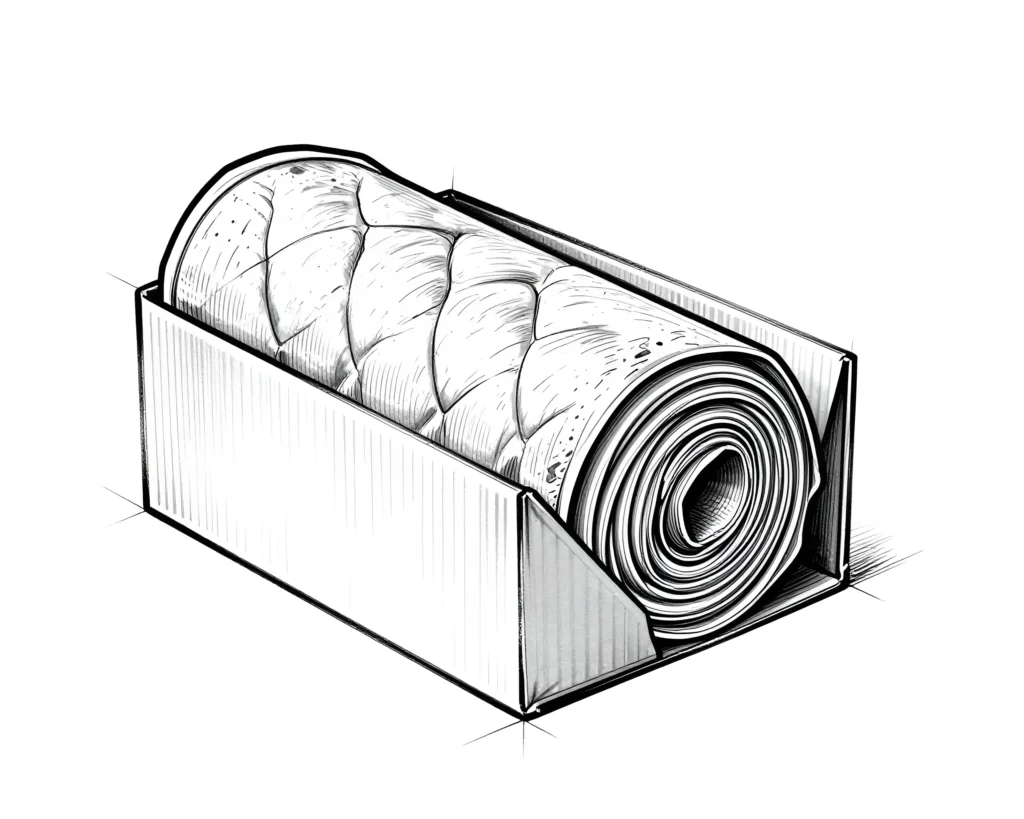
You have just received a box that looks like a giant scroll, and inside it is your new mattress, compressed to a size it wouldn't fit into in its normal state. This is a mattress in a roll, and the first question every buyer asks is: what should I do with it right now, can I go to sleep immediately, and how do I avoid damaging the filler while unpacking? In this article, I will break down the entire process from opening the box to the moment the mattress is fully ready for use, including specific timelines, temperature conditions, and common mistakes that most people make.
Mattress in a roll: what it is and why it is so popular
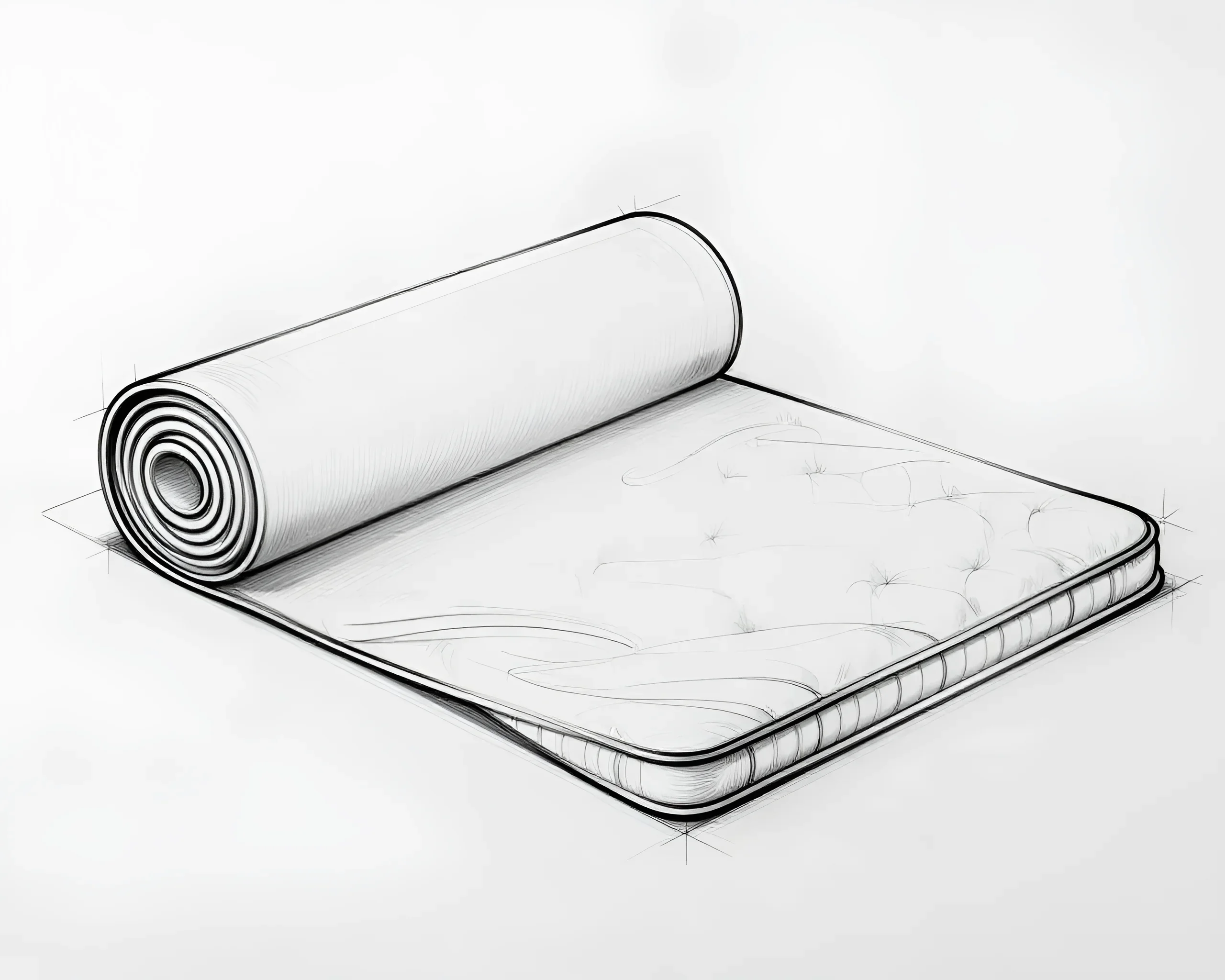
A mattress in a roll is a standard mattress that is compressed with a roller before packaging and placed in a cardboard box with shrink wrap. The technology allows for the delivery of a 190×200 cm product in a box that fits through a 60 cm wide doorway and into a standard apartment building elevator. This is why the format is popular: you don't have to order delivery with floor-to-floor transport, you don't have to disassemble the bed, and you don't have to call friends to help carry bulky packaging.
Compression is achieved due to the properties of the fillers. Polyurethane foam, memory foam, latex, and coconut coir return to their original shape elastically after the pressure is released. Manufacturers use vacuum or mechanical compression: the mattress is rolled up, tightly wrapped in film, and placed in a box. In some models, there is air inside that maintains the shape under pressure; in others, the filler is simply compressed and held by its own elasticity.
Key advantages of the format for the buyer:
- Easy logistics. The box weighs from 12 to 30 kg depending on the size and filler, and it can be carried by one person.
- Compactness. A standard 190×200 cm box has a roll diameter of about 40–50 cm and a length of 90–100 cm, which is convenient for storage and transport.
- Wide selection. Both budget foam mattresses and premium combined models with latex and coconut are available in roll packaging.
- Integrity guarantee. Airtight packaging protects the filler from dust, moisture, and deformation until the moment of unpacking.
It is important to understand that a mattress in a roll is not a simplified or "light" version. In terms of filler composition, firmness, and orthopedic properties, it is no different from a mattress in flat packaging. The only difference is in the delivery method and the first stage after opening: a compressed mattress needs time to restore its volume.
How to properly unpack a mattress in a box: step-by-step instructions
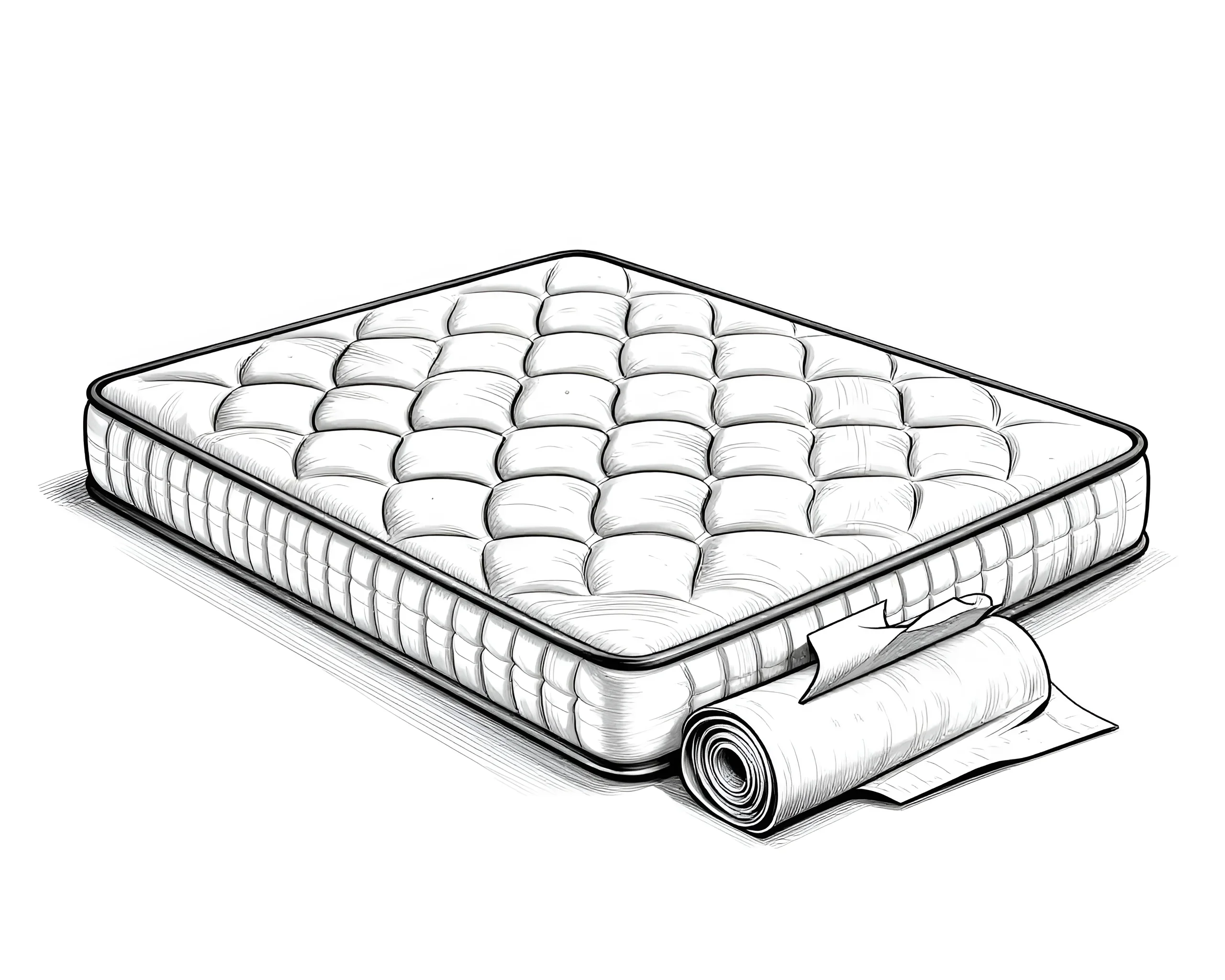
Unpacking takes 5 to 15 minutes, but whether the mattress retains its stated characteristics depends on doing it correctly. Let's break down the process step-by-step, taking typical situations into account.
Step 1. Prepare the space. Unpack the mattress directly in the bedroom, on the base where it will stand, or on a clean floor nearby. Do not open the box in the hallway or kitchen — a compressed mattress takes up 3–4 times more space when unrolled than the box does, and you will need room for it to expand.
Step 2. Open the box. Use a utility knife or a shoemaker's knife, not scissors. Scissors tear the cardboard and can catch the film, while a utility knife makes a clean cut. Cut the side walls of the box along the seams without making holes in the bottom and lid — this way you will save the box in case of a return or move. Remove the top and bottom lids, then carefully take out the roll.
Step 3. Remove the shrink wrap. This is the most critical moment. Do not pull the film with jerks and do not cut it with a knife — the blade will easily cut through the mattress cover. Find the edge of the film (usually it is tucked inside or has a small notch) and remove it slowly, in a spiral, from the edge to the center. If the film is stuck to the cover, do not pull — pry it with the dull edge of a knife or a plastic card and continue pulling. This takes 3–5 minutes.
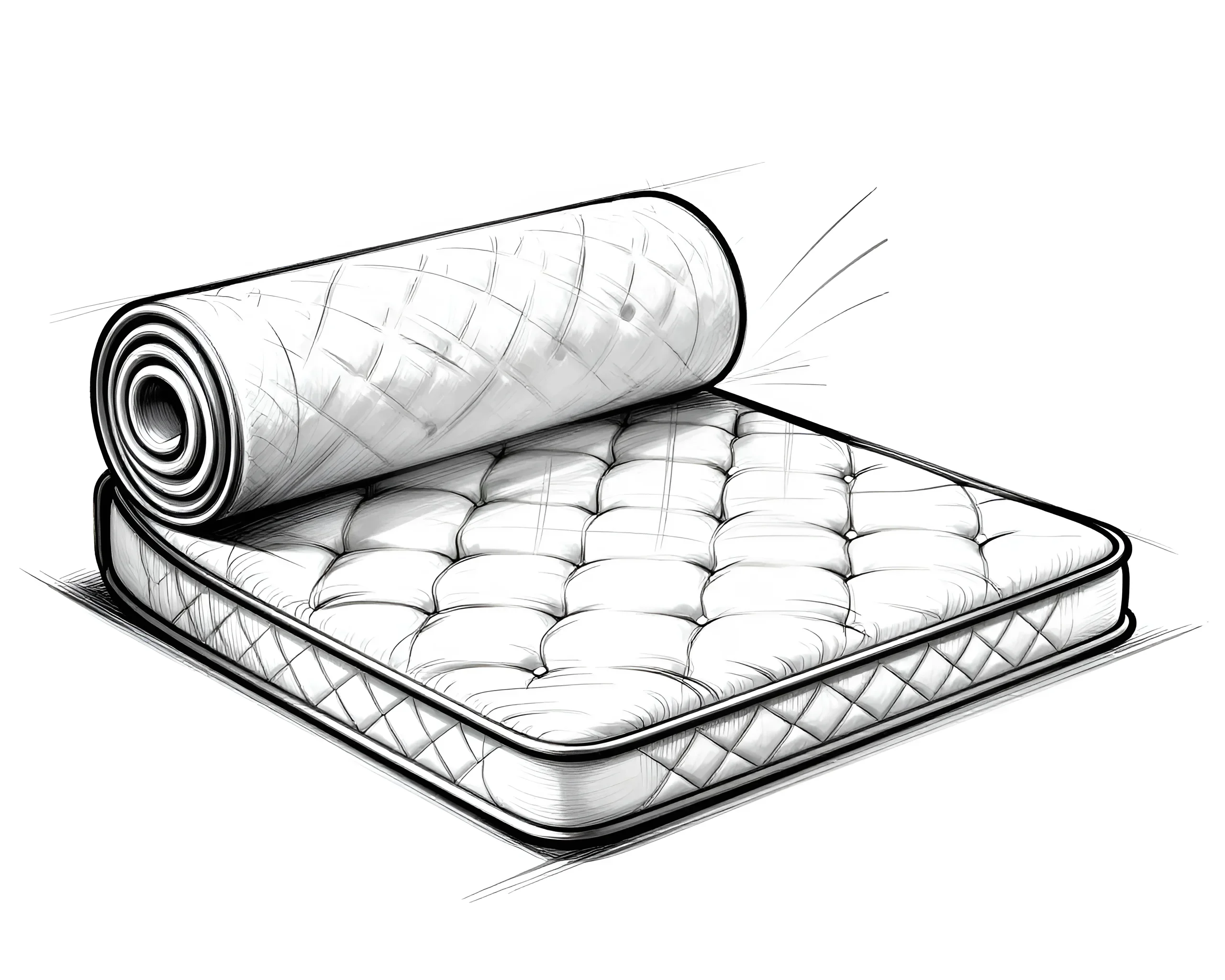
Step 4. Unroll the roll. Place the roll on the mattress base or on a clean floor. Start unrolling it from one edge to the other like a carpet. Do not unroll it abruptly and do not jump on it — the filler is still compressed and can deform. Unroll it smoothly, guiding the roll forward. If the mattress does not unroll completely and a "donut" remains in the center, this is normal: the inner layer has not yet opened.
Step 5. Remove the inner layers of film. Many mattresses have a second layer of film inside the roll that holds the shape. When the outer layer is removed and the roll is unrolled, you will see an inner roll wrapped in film. Remove it just as carefully, in a spiral. After this, the mattress will start to expand on its own.
Step 6. Final expansion. Turn the mattress over to the other side, then onto its back, then onto its side again. This will help the filler expand evenly across the entire surface. Walk over the mattress with your hands, smoothing out the folds of the cover. Do not use an iron, hairdryer, or other heat sources to help it expand — this will destroy the foam structure and void the warranty.
Step 7. Check the cover. Inspect the cover for damage, pulls, or knife marks. Check the zipper: it should zip and unzip without snagging. If the cover is removable, make sure it fits tightly and does not slip.
How long does it take for a mattress to fully expand
This is the main question, and the answer depends on the type of filler, room temperature, and humidity. A mattress does not expand instantly: foam and latex need time to restore air channels and regain volume. Below are the estimated timelines by filler type.
Polyurethane foam (PU foam). A budget filler that expands the fastest. First visible volume — in 1–2 hours, full recovery — in 6–12 hours. At room temperatures above 22 °C, the process is faster; below 18 °C, it is slower.
Memory foam. A denser structure that expands more slowly. First volume — in 2–4 hours, full recovery — in 24–48 hours. In a cool room, memory foam can take up to 72 hours to "finish," but this is a rare case.
Latex (natural and synthetic). Latex is elastic and expands quickly: first volume — in 1–3 hours, full recovery — in 12–24 hours. Natural latex is slightly slower than synthetic due to its denser cellular structure.
Coconut coir. A firm filler that hardly compresses in a roll and expands almost immediately — within 30–60 minutes. In combined mattresses, coir acts as a firm base and does not affect the overall expansion time.
Combined fillers. If a mattress has several layers (e.g., memory foam + latex + coir), focus on the slowest layer. Usually, this is memory foam, so full recovery takes 24–48 hours.
Temperature and humidity greatly affect the process. At 20–25 °C and 40–60% humidity, the mattress expands normally. In a cold room (below 15 °C), the foam becomes stiffer and expands 1.5–2 times slower. In a hot, dry room, the process accelerates, but too high a temperature (above 30 °C) can dry out the cover and filler, so do not place the mattress in direct sunlight and do not turn on a heater right next to it.
Practical tip: do not try to accelerate expansion mechanically — by jumping, pressing, or rolling it back. This deforms the filler and may lead to the mattress not expanding completely. Just give it time and ensure a normal temperature in the room.
The smell of a new mattress: what is normal and what should be alarming
The smell of a new mattress is one of the most common causes for concern, and it is important to distinguish the norm from a problem. Any new mattress, especially in roll packaging, has a characteristic smell that arises from the compression of fillers and cover materials.
What is considered normal:
- A light smell of foam or plastic, reminiscent of a new car interior or a plastic bottle. It appears due to polyurethane foam and memory foam and goes away within 2–7 days with ventilation.
- The smell of latex, which resembles rubber or nuts. Natural latex has a distinct smell that dissipates in 3–14 days.
- A light smell of the cover fabric, especially if it is new and has not been aired out. Goes away in 1–3 days.
- A neutral "boxed" smell that simply appears after long storage in airtight packaging.
These smells are safe and do not indicate a defect. They are related to volatile compounds that are released from the fillers in the first days after unpacking. Under normal conditions, they completely dissipate, and the mattress becomes neutral in smell.
What should be alarming:
- A sharp chemical smell reminiscent of acetone, gasoline, or solvent. Such a smell is not characteristic of high-quality fillers and may indicate the use of low-quality binders or glue.
- A smell that causes dizziness, nausea, or irritation of the eyes or mucous membranes. If it is difficult to stay in the room after unpacking, ventilate the room and let the mattress sit in a ventilated place for 2–3 days. If the smell does not go away and causes discomfort, this is a reason to contact the seller.
- A smell of mold or dampness. It appears if the mattress was stored in damp conditions or the packaging was damaged. Such a mattress is not suitable for use and is subject to return.
- A smell that intensifies over time instead of going away. A normal new mattress smell fades day by day, not increases.
How to speed up the dissipation of the smell: ventilate the room 2–3 times a day for 30–60 minutes, do not cover the mattress with film after unpacking, and do not put it in a closed closet or under the bed without ventilation gaps. Do not use aerosols, air fresheners, or chemical agents to remove the smell — they do not solve the problem and can be absorbed into the filler. If the smell is normal, it will go away on its own in a few days.
Important: do not confuse "new mattress smell" with "defect smell." The first is light, short-term, and does not cause discomfort. The second is sharp, persistent, and causes a bodily reaction. If in doubt, compare your sensations: you only feel a normal smell when leaning towards the mattress, while you feel a problematic one while standing several meters away from it.
Common mistakes when unpacking and installing a mattress in a roll
Most problems with mattresses in a roll arise not because of the product itself, but because of mistakes during the unpacking and installation stage. Let's look at the most frequent ones so you can avoid them.
Mistake 1: Unpacking in the wrong place. Many people open the box in the hallway or kitchen and then carry the mattress to the bedroom. The problem is that a compressed mattress can deform during transport, and the cover can catch on a door frame. Unpack directly in the bedroom, on the base where the mattress will stand.
Mistake 2: Cutting the film with a knife. This is the most common mistake. A knife blade will easily cut the cover, especially if it is thin. The result is a snag that will grow over time and the loss of the warranty. Remove the film only with your hands, prying the edge.
Mistake 3: Abrupt unrolling and jumping. The desire to expand the mattress faster leads to the filler deforming unevenly. Jumping on a compressed mattress can break the spring block (if there is one) or damage the foam layers. Unroll smoothly, without jerks.
Mistake 4: Using heat to accelerate. An iron, hairdryer, heater, radiator — all these destroy the foam and latex structure. Foam deforms irreversibly under local heat, and the mattress sags in the heated areas. Do not accelerate the process with heat.
Mistake 5: Installing on an unsuitable base. A mattress in a roll is often bought for new bases, and incompatibility arises here. If the base has gaps between slats of more than 5 cm, the mattress sags. If the slats are broken or the base is deformed, the mattress will not lie flat. Check the base before installation.
Mistake 6: Ignoring the orientation of the mattress. Many mattresses have "top" and "bottom" markings. If you put the mattress upside down, the orthopedic properties will be impaired, and the cover may wear out faster. Check the label before installation.
Mistake 7: Lack of ventilation after unpacking. A mattress that is immediately covered with a bedspread or sheet airs out more slowly. Leave it open for 24–48 hours so that the filler opens up completely and the smell goes away.
Mistake 8: Incorrect storage of the box. After unpacking, many people throw away the box and then face a problem with returns or moving. Keep the box for 14 days — this is the standard return period. If the box is damaged, a return may be difficult, so store it carefully.
When can you sleep on the mattress after unpacking: time guidelines
Technically, you can lie on the mattress immediately after unpacking, but for a comfortable and safe sleep, it is better to wait. Below are practical guidelines by filler type and storage conditions.
You can sleep after:
- 1–2 hours — if the filler is polyurethane foam and the room temperature is above 22 °C. The mattress will expand by 80–90%, and you can sleep on it, but it has not yet reached its full volume.
- 6–12 hours — for polyurethane foam under normal conditions. The mattress will expand completely, and this is the optimal time for the first sleep.
- 24 hours — for memory foam and combined mattresses. The mattress will reach 95–100% volume, and it will be comfortable to sleep on.
- 48 hours — for memory foam in a cool room or for mattresses with a thick layer of latex. Full recovery, the smell is almost gone.
If you don't want to wait, you can lie on the mattress 2–3 hours after unpacking, but with caveats: the filler has not yet reached its full volume, so the mattress may seem slightly firmer or softer than it will be in a day. This is normal and not a defect. After 24–48 hours, the mattress will "reach" its stated characteristics.
Practical tip: if you are unpacking the mattress in the evening and want to sleep immediately — ventilate the room, unroll the mattress completely, and lie down in 1–2 hours. In the morning, you will feel that the mattress has become softer and more voluminous. This does not mean it has "floated" — the filler has simply opened up. If the mattress seems too soft or firm after the first sleep, give it another day — sometimes the filler "settles" over 3–5 days.
Do not sleep on the mattress if:
- It has not fully expanded and there is a roll or fold in the center.
- The cover is damaged or there are snags that could spread.
- The smell causes discomfort — it is better to ventilate and wait.
- The mattress base is not ready (slats not installed, base is damp or dirty).
How to prepare the sleeping area before installing the mattress
A mattress in a roll is often bought together with a new base or for an existing bed, and the preparation of the place affects how long the mattress will last and how comfortable it will be to sleep on. Let's break down what needs to be done before unpacking.
Check the base. Inspect the slats or solid base for damage. The slats should not be broken, bent, or creaking. The gap between the slats should be no more than 5 cm, otherwise, the mattress sags. If the base is old and deformed, the mattress will lie unevenly and quickly lose its shape. In this case, it is better to replace the base.
Cleanliness. Vacuum the base and remove dust, hair, and crumbs. Dust under the mattress creates unevenness and can cause sagging. If the base is damp (e.g., after washing), let it dry completely — at least 12 hours. A mattress on a damp base will quickly absorb moisture and start to smell of dampness.
Ventilation. There must be a gap between the base and the mattress for air circulation. If the bed has a solid bottom without ventilation holes, put a thin mesh under the mattress or use a base with slats. Air blockage under the mattress leads to moisture accumulation and the appearance of a smell.
Base size. Make sure the base matches the size of the mattress. A 160×200 cm mattress should lie on a 160×200 cm base. If the base is smaller, the mattress will hang and deform. If it is larger, the mattress will shift and not lie flat. The permissible discrepancy is no more than 2 cm on each side.
Room temperature. Before unpacking, warm the room to 20–25 °C. If the mattress was stored in a warehouse or a car, it may be cold, and it expands more slowly in a cool room. Turn on the heating 2–3 hours before unpacking so that the filler restores its volume faster.
Floor covering. If the mattress will be on the floor (without a bed), make sure the floor is flat, dry, and clean. On a carpet or soft covering, the mattress will sag. On tile or laminate, put a thin pad underneath so the mattress does not slide and does not absorb cold.
Frequently asked questions about mattresses in a roll and interesting facts
How many times can a mattress be rolled up? Once — in production. After unpacking, the mattress is not intended for re-rolling. If you roll it up for a move, the filler will deform and may not expand completely. For a move, it is better to use flat packaging or transport the mattress in an unrolled state.
Can a mattress in a roll be used on a sofa bed? Yes, if the size of the sofa corresponds to the size of the mattress. But keep in mind that a sofa bed has a fold in the center, and the mattress will sag on it. For constant sleep, it is better to use a bed or a base without folds.
Do you need to flip a mattress in a roll? If the mattress is double-sided (with the same fillers on both sides), flipping it is not necessary, but you can do it every 3–6 months for even wear. If the mattress is single-sided (firmer on one side, softer on the other), it cannot be flipped — only rotated lengthwise every 3 months.
What to do if the mattress has not expanded after 48 hours? Check the room temperature: if it is below 18 °C, give it another 24–48 hours. If the temperature is normal and the mattress has not expanded, the filler may have been damaged during transport. In this case, contact the seller — this is a warranty case.
Can you sleep on a mattress in a roll immediately after unpacking? Technically yes, but it is better to wait 2–6 hours depending on the filler. The mattress will not reach its full volume, and the first sleep may be less comfortable. After 24–48 hours, the mattress will "reach" its stated characteristics.
How to store the box after unpacking? 14 days — the standard return period. Store the box in a dry place, do not put heavy objects on it. If the box is damaged, a return may be difficult, so store it carefully.
Interesting facts:
- The first mattresses in roll packaging appeared in the 1990s, when manufacturers began using high-resilience polyurethane foam. Before this, mattresses were delivered only in flat packaging.
- Compressing a mattress into a roll reduces its volume by 3–4 times: a 190×200×25 cm mattress in a box takes up 90×50×50 cm of space.
- Memory foam was developed in the 1960s for NASA to reduce the load on astronauts' bodies during rocket launches. It has been used in mattresses since the 1990s.
- Natural latex is obtained from the sap of the rubber tree, and the sap from several trees is used to produce one mattress. This is why latex mattresses are more expensive than foam mattresses.
- Coconut coir is a fiber from the husk of a coconut. One coconut gives about 200 grams of fiber, so fiber from dozens of nuts is used for one mattress.
- The smell of a new mattress is not "chemicals," but volatile compounds that are released from the fillers in the first days. They are safe and completely dissipate in 1–2 weeks.
- A mattress in a roll weighs 1.5–2 times less than it seems by size because the filler is compressed. A 190×200×25 cm mattress can weigh only 15–20 kg.
Conclusion: a mattress in a roll is a convenient delivery format that is not inferior in quality to flat mattresses. The main thing is to unpack it correctly, give the filler time to recover, and not try to accelerate the process mechanically or with heat. If you follow these simple rules, the mattress will serve you as long as stated by the manufacturer and ensure a comfortable sleep from the first day.


