Imagine: you finally got into bed after a long day, and ten minutes later you wake up from the cold — the sheet doesn't keep you warm, and there's a draft nearby. Or, conversely, in March you are suffocating under a winter down duvet that you never put away in the closet. Familiar situation? Then this article is for you. We will analyze how to choose a blanket by season so that you sleep comfortably every night, without stuffiness or shivering. We will break down warmth classes, compare fillers, choose the size for your mattress, and tell you how to care for your blanket so it lasts more than one season.
Warmth classes and main types of blankets
The first thing an informed choice of a blanket starts with is understanding that blankets are divided into classes according to the level of thermal insulation. In domestic and European practice, there are three main classes, although labeling may vary slightly among different manufacturers.
- Summer blanket (class 1, "light") — filler density from 100 to 200 g/m². Designed for a bedroom night temperature of +20 °C and above. Thin, airy, does not create a greenhouse effect. Ideal for apartments with warm central heating, where the air warms up to +22…+25 °C in winter, and in summer you sleep with an open window or air conditioning on.
- Autumn-winter / off-season (class 2, "medium") — density from 200 to 350 g/m². A universal option for most regions. Suitable when the bedroom is +16…+20 °C. It does not overheat and does not let you freeze.
- Winter blanket (class 3, "warm") — density from 350 to 600 g/m² and above. For bedrooms with temperatures down to +16 °C, for private houses without central heating, for people who get cold even at +20 °C. Heavy, voluminous, retains body heat for a long time.
In addition to the warmth class, blankets are divided by construction type. Classic blanket — a single sheet with filler that you put on yourself. Quilted blanket — the filler is fixed in "pockets" (stitching), so it does not clump over time. Sleeping bag blanket — has the shape of a bag or half-bag, convenient for those who toss and turn. Bedspread blanket — a decorative top layer that simultaneously serves as a light insulator.
An important nuance: the warmth class is not a sentence. If you sleep together and one of you gets cold while the other sweats, it is better to take two blankets of different classes or a "2-in-1" model. Also, consider that a class 3 blanket in a bedroom with air conditioning at +24 °C will turn into torture, and a summer blanket in an unheated room at +12 °C will not save you from the cold.
Blanket materials: pros and cons of natural and synthetic fillers
The filler determines 80% of the sleep experience. Let's honestly compare the main options so you can choose according to your climate, budget, and skin sensitivity.
Down and feather (goose, duck)
- Pros: maximum thermal insulation with minimum weight; breathability — the body "breathes"; durability (a high-quality down blanket lasts 15–20 years); hypoallergenic when properly processed.
- Cons: high price; requires regular airing and drying; down can migrate if stitching wears out; not recommended for feather allergies.
- Practical advice: look for a blanket with at least 70% down content (the rest is feather). The higher the percentage of down, the lighter and warmer it is. For winter, take a density of 400–600 g/m², for summer — 100–150 g/m².
Wool (sheep, camel, cashmere)
- Pros: excellent moisture wicking (wool absorbs up to 30% of its own weight and does not get wet); antibacterial properties; warm but not hot; durable.
- Cons: heavier than down; can prick if in direct contact with skin (solved with a cover); requires careful washing; camel wool is more expensive than sheep wool.
- Practical advice: a camel blanket is top-tier for people who sweat in their sleep. It does not create a greenhouse effect, unlike synthetics. For allergy sufferers, sheep wool is better than feathers.
Cotton (cotton blanket)
- Pros: affordable price; hypoallergenic; easy to wash; does not electrify.
- Cons: heavy; clumps over time; poor moisture wicking — can be damp; not as warm as down at the same thickness.
- Practical advice: suitable for summer and off-season. For winter, you would have to take a very dense cotton blanket, and it would weigh 4–6 kg, which is inconvenient for washing.
Synthetic fillers (sintepon, hollowfiber, siliconized sintepon, membrane materials)
- Pros: low price; does not cause allergies; easy to machine wash; does not clump (if the stitching is high quality); lightweight.
- Cons: wicks moisture worse — the body sweats under synthetics; over time (3–5 years) the filler degrades; can electrify; not as durable as natural ones.
- Practical advice: if you choose synthetics, take siliconized hollowfiber — it is softer, does not clump, and holds its shape better. Density for winter — 300–400 g/m², for summer — 100–150 g/m².
Combined fillers — for example, down + wool, or cotton + sintepon. They provide a balance: the natural component ensures "breathing", the synthetic one ensures lightness and ease of care.
Thermal efficiency of fillers at the same density (approximate): down > camel wool > sheep wool > cotton > siliconized sintepon > regular sintepon. But this does not mean that synthetics are "bad" — for a summer blanket or for a child in kindergarten, they are ideal.
All-season blankets and "2-in-1" models: how to get the most out of one purchase
If you have little storage space or don't want to remake the bed twice a year, all-season solutions are your option. Let's analyze three main types.
"2-in-1" model (two blankets in one)
These are two blankets of different classes connected by buttons, zippers, or Velcro. In summer you use the light one (100–150 g/m²), in winter — the dense one (300–400 g/m²), and in autumn and spring — both together (total density 400–550 g/m²). In essence, you get three blankets in one. A zipper construction is more convenient than buttons: the blankets don't slide apart in your sleep, and you can quickly change the configuration.
What to look for when buying "2-in-1":
- Both blankets must be the same size, otherwise "steps" will form when connected.
- The zipper must be covered with a flap so as not to scratch the skin.
- Fillers in both layers are better taken from the same category (e.g., down + down), so the blanket lies flat.
- The weight of the assembled pair should not exceed 5–6 kg, otherwise washing and drying will become a problem.
All-season blanket with adjustable density
Some manufacturers make a blanket with an internal removable layer. For example, a base layer of 200 g/m² + an additional removable layer of 150 g/m². In summer — only the base, in winter — both layers. This is more convenient than "2-in-1" because there is no seam in the middle.
Blanket with a membrane
Modern models with a membrane top layer wick moisture out and do not let cold air in. Such blankets are suitable for people who sweat but are afraid of drafts.
Practical advice: if you live in a region with sharp temperature changes, a "2-in-1" model with down filler is the optimal choice.
Sizes and density: how to choose a blanket for your mattress and climate
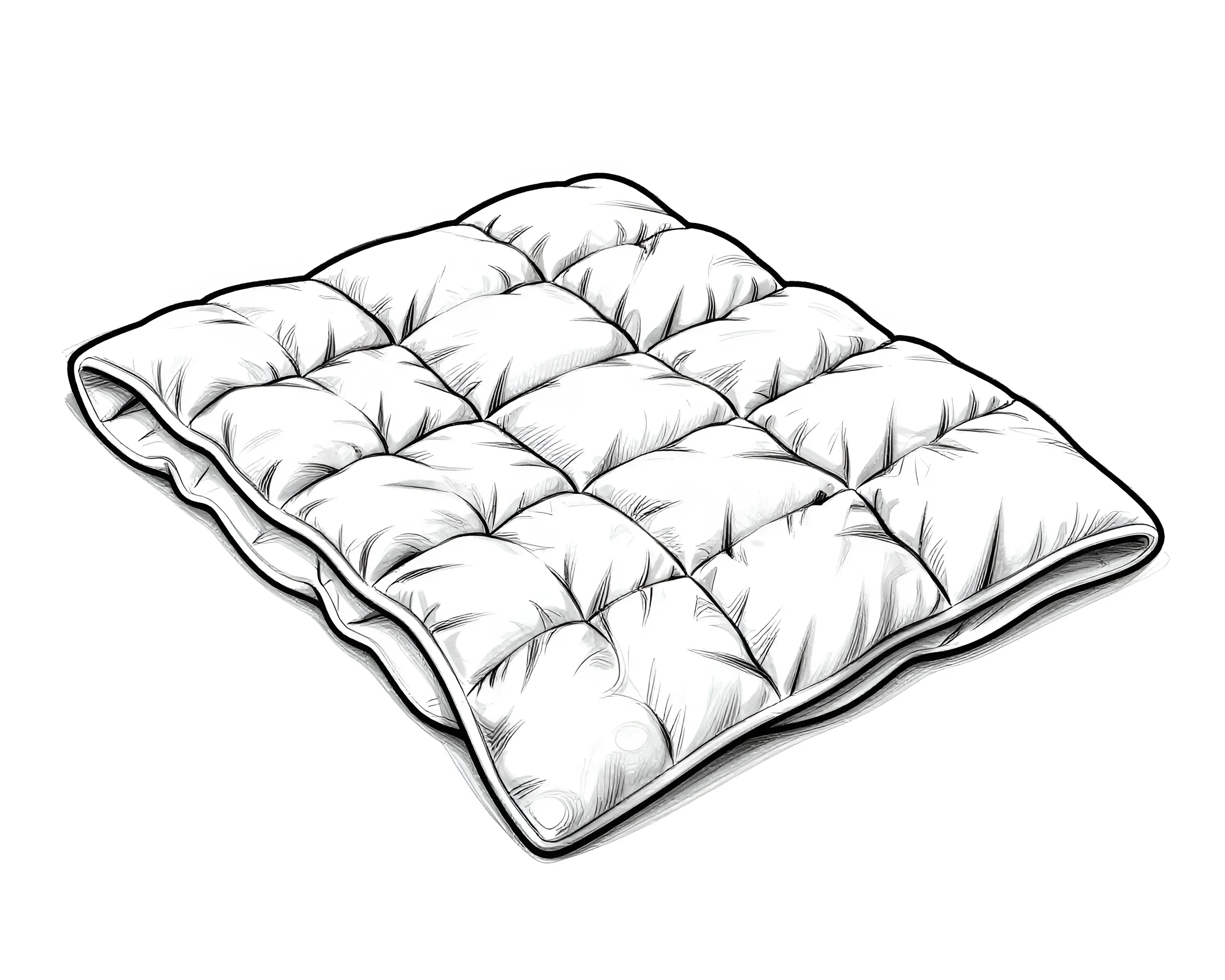
The most common misconception: "a blanket should be 20 cm larger than the mattress on each side." In practice, this leads to the blanket constantly sliding off. Let's figure it out.
Standard blanket sizes (width × length, cm):
- 140 × 205 — for a single mattress. Suitable for children.
- 172 × 205 — for a single mattress. Minimum comfortable size for one adult.
- 200 × 220 — for a one-and-a-half mattress. Most popular size.
- 220 × 220 — for a double mattress. Compromise for two.
- 240 × 220 — for a double mattress. Comfort for two.
- 260 × 220 — for a double mattress (king size).
Selection rule: the blanket should be 15–20 cm wider than the mattress on each side and 15–20 cm longer. That is, for a 160 × 200 mattress, take a 200 × 220 or 220 × 220 blanket.
Density and weight:
- Summer blanket 200 × 220 weighs 1–1.5 kg.
- Off-season — 1.5–2.5 kg.
- Winter — 2.5–4 kg (down) or 3–5 kg (synthetic, cotton).
If the blanket weighs more than 5 kg, it will be difficult for you to wash, dry, and remake it. For elderly people and children, it is better to limit it to 3 kg maximum.
How to choose a blanket by season: practical tips for different conditions
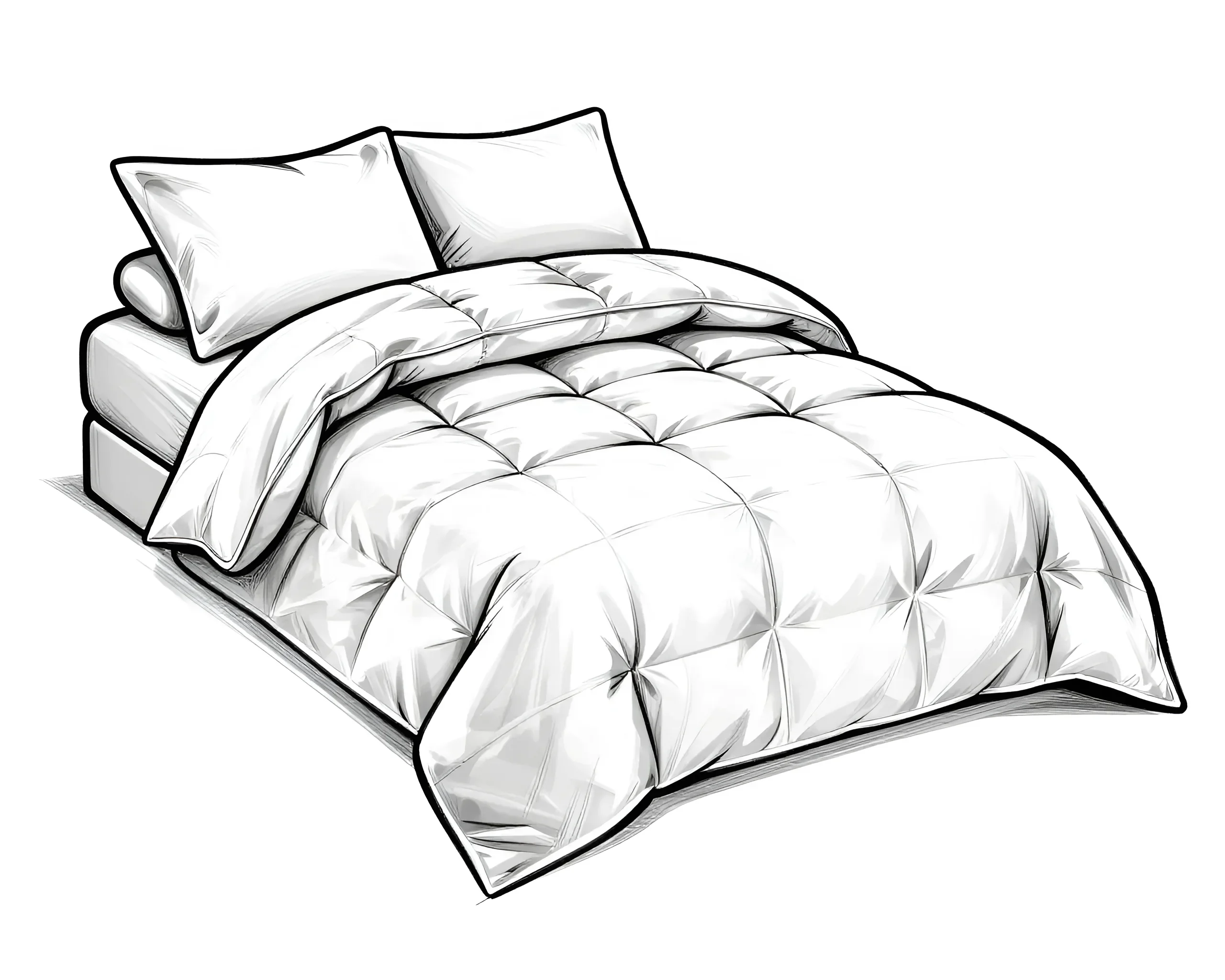
Now let's connect theory with practice. Here are specific scenarios and recommendations.
Sleep alone, get cold, in an apartment with central heating
Take a winter class 3 blanket with a density of 400–500 g/m². Filler — down or camel wool. Size — 20 cm larger than the mattress on each side so you can wrap yourself in a "cocoon".
Sleep together, one gets cold, the other sweats
Option 1: two separate blankets of different classes. Option 2: a "2-in-1" model, but in this case, the one who gets cold will use both layers, and the one who sweats — only the light one. Option 3: one class 2 blanket (250–300 g/m²) + an extra throw for the one who gets cold.
Sleep in a private house without central heating
Here, even a winter class 3 blanket may not save you if the bedroom is +10…+14 °C. Take a down blanket 500–600 g/m² + a warm fleece or wool cover. Additionally — warm socks for sleeping and a hot water bottle.
Child (under 3 years old)
For infants under 6 months, a swaddle is enough, no blanket needed. From 6 months to 3 years — a light blanket 100–150 g/m² made of cotton or hypoallergenic sintepon. Important: the blanket should not be heavy (maximum 500 g) so the child can throw it off. Never put a down blanket on a child under 1 year old — risk of overheating and suffocation.
Elderly people
Heavy blankets (over 4 kg) are inconvenient for them. Take a down or wool blanket 300–400 g/m², weight 2–3 kg. It is warm but light.
Allergies and asthma
Exclude down and feathers if there is a confirmed allergy. Best of all — synthetic hypoallergenic filler (siliconized hollowfiber) or cotton. Washing — weekly at 60 °C.
Care and washing: how to extend the life of a blanket and keep it warm
Even the most expensive down blanket will lose 30–40% of its thermal insulation if not cared for properly.
Washing:
- Read the label. If it says "dry clean only" — take it to the dry cleaner.
- Synthetic and cotton blankets can be machine washed at 30–40 °C on a delicate cycle. Down — at 30 °C, no spin.
- Use a liquid detergent without bleach.
- Add 3–5 tennis balls to the drum when washing a down blanket — they will break up down clumps.
Drying:
- Never dry a down or wool blanket on a radiator.
- Dry horizontally on a drying rack or spread on the floor in a ventilated room.
- Full drying of a down blanket takes 2–3 days.
Storage:
- Store the blanket in a breathable material cover (cotton, linen). Do not store in plastic.
- Before storing, air the blanket for 2–3 hours in the open air.
Service life:
- Down blanket: 15–20 years.
- Wool: 10–15 years.
- Cotton: 5–8 years.
- Synthetic: 3–5 years.
Top popular models and brands: what buyers choose
The blanket market is represented by both local and international brands. Here are some names to pay attention to.
Budget segment: "Son i lyubov", "Teply dom" — specialize in cotton and synthetic blankets. Good price/quality ratio.
Middle segment: "Sonka", "Myagky dom" — offer down, wool, and combined fillers. "2-in-1" models with zippers.
Premium segment: "Schlummer" (Germany) — one of the oldest manufacturers of down products. "Hästens" (Sweden) — camel wool, cashmere.
What to look for when choosing a brand (checklist):
- Filler composition: percentage of down/feather/wool/synthetics.
- Density g/m²: should match your season.
- Stitching type: diamond, square, strip.
- Cover: satin (120–150 threads) for summer, percale (170–200 threads) for winter.
Frequent questions and interesting facts about winter and summer blankets
How many blankets do you need in an apartment? At least two: summer (100–150 g/m²) and winter (400–500 g/m²). If you have a "2-in-1" model, then effectively one blanket plays the role of three.
How to understand that a blanket has become "not warm"? Signs: filler has clumped, "cold spots" have appeared, the weight of the blanket has decreased by 20–30% from the original, the cover has worn through.
Is it true that a down blanket gets "heavier" over time? No, on the contrary — it loses weight because the down degrades and partially spills out through the stitching. If the blanket has become 300–500 g lighter in 5 years — this is normal. If by 1–2 kg — the stitching is damaged, and the blanket needs to be repaired or replaced.


