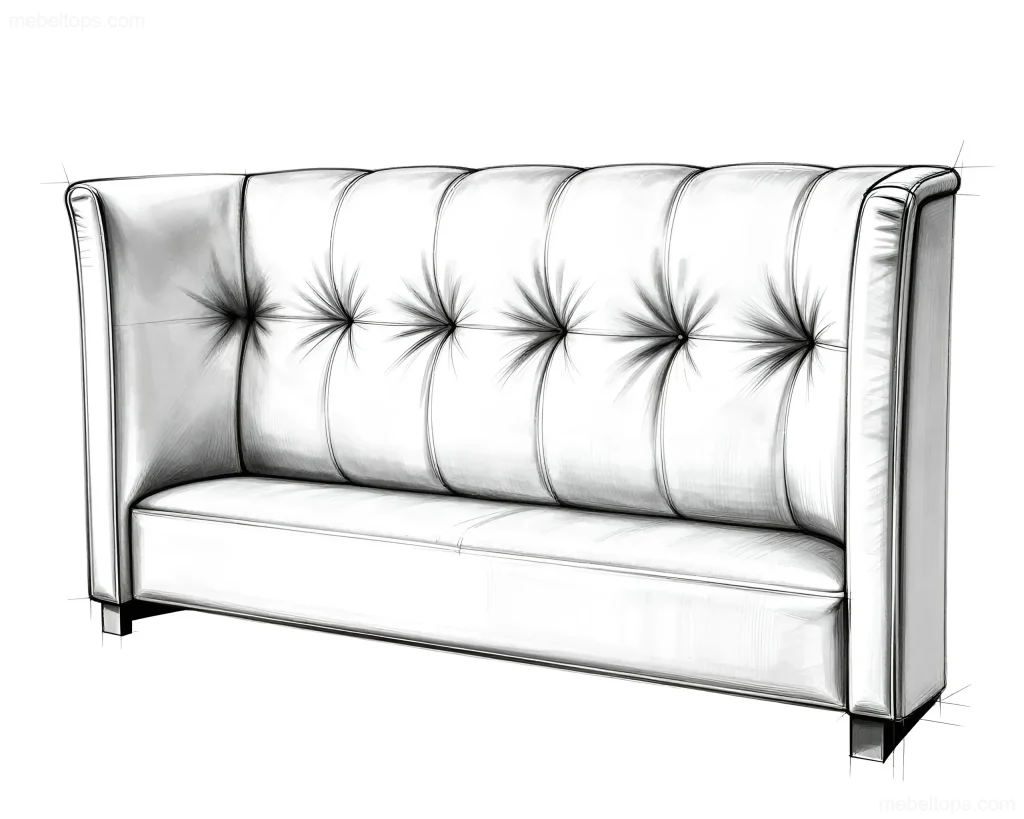
A headboard is not just a decorative detail at the head of the bed. It is your daily back support, a panel for reading in bed, a place where you intuitively put your phone before sleep, and, ideally, an element that makes the bedroom look visually complete. Yet, most people choose a headboard "by eye," without thinking about whether its height matches their stature, what backrest angle is comfortable for reading, or why a soft panel with the right stitching geometry can reduce bedroom noise by several decibels. In this article, we will break down every aspect—from ergonomics to hidden utilities—so you can make an informed decision and not regret your choice in six months.
Headboard Ergonomics: How to Match Height and Tilt to Your Stature
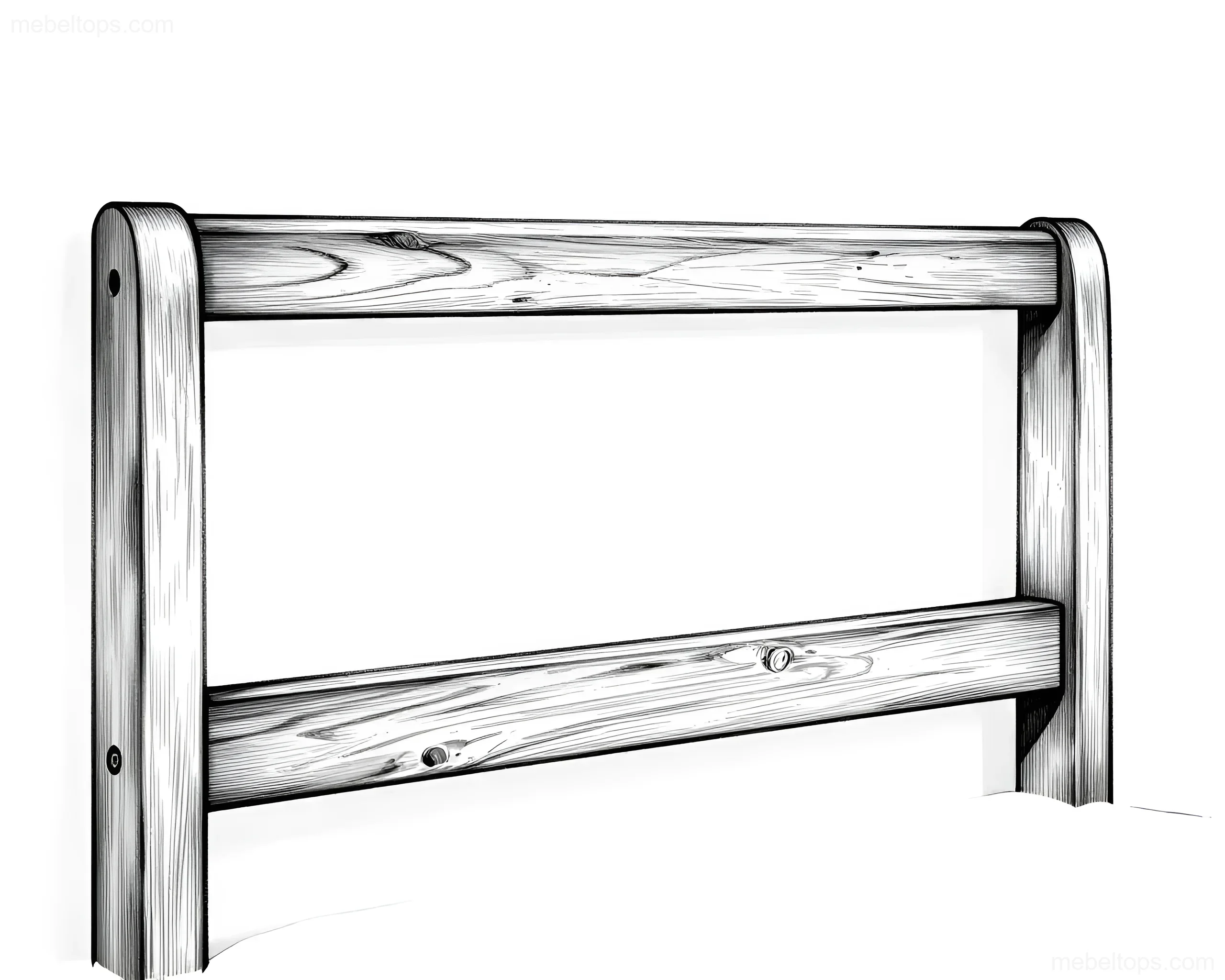
The first thing to understand: there is no universal "correct" headboard height. There is a height that suits you specifically, and it is determined not by your standing height, but by your body position when sitting on the bed, leaning your back against the panel. Here is a simple formula used by furniture makers when designing production models.
The optimal top edge of the headboard should be at a level of 110–130 cm from the floor for a standard bed with an 18–22 cm thick mattress. But this is just a starting point. The exact calculation is done as follows:
- Sit on the bed in the footwear you usually wear when reading or working in bed.
- Place your elbow at the level where you hold a book or tablet—this is approximately 60–70 cm from the seat.
- The top edge of the headboard should be 10–15 cm above this elbow level so that your shoulders do not "hit" the panel, but you can still lean back comfortably.
For a person 160–165 cm tall, a comfortable headboard height from the floor is about 105–115 cm. For a height of 175–180 cm—115–125 cm. If you are taller than 185 cm, look for models with a height from 125 to 140 cm. Note: this refers specifically to the height from the floor to the top edge, not the height of the panel itself. If the bed is on 12 cm legs and the mattress is 20 cm, the sitting surface is 32 cm from the floor, and the headboard panel should rise another 75–95 cm from that point.
Now about the tilt. A straight, vertical headboard (90° angle to the mattress plane) is suitable for those who use it exclusively as back support in a "sitting" position. If you plan to read, work on a laptop, or just lounge, look for models with a backrest tilt of 100–110° (i.e., a deviation from the vertical by 10–10° backwards). Such an angle relieves the lower back and allows the body to take a natural S-shape. Some modern beds with a mattress lift mechanism (so-called "transformer headboards") allow adjusting the angle from 90° to 135°, and this is perhaps the most ergonomic solution for those who spend more than two hours a day in bed reading or watching content.
Another nuance often missed: seating depth. If the headboard has a pronounced "waist" or concave shape, it hugs the shoulders better and prevents the body from sliding forward. The depth of such concavity should be 8–12 cm from the wall plane to the most protruding point of the panel. A concavity that is too shallow (less than 5 cm) provides no support, while one that is too deep (more than 15 cm) creates the feeling that you are "sinking" into the panel.
Practical tip: before buying, ask in the store to sit on the bed with this headboard and hold a book or tablet for at least 10 minutes. It is after a few minutes that it becomes clear whether the panel is pressing on your shoulder blades, whether it "goes" too far back, and whether it is convenient to put your phone on it. Ten minutes is the minimum time for your back muscles to adapt and for you to get an honest sense of comfort.
Materials and Tactility: From Soft Panels to Solid Wood
Tactile contact with the headboard is what you feel every evening when you lean back after a workday. Therefore, the choice of upholstery or finish material is not just a question of aesthetics, but a question of daily physical sensation. Let's break down the main options in order.
Soft panels with filler. A classic option for most modern headboards. The filler can be different:
- Foam rubber (polyurethane foam) — density 25–35 kg/m³ for headboards. The higher the density, the longer the panel holds its shape and does not "sag" in leaning areas. For a headboard you lean on every evening, take at least 30 kg/m³. Thin foam 15–20 kg/m³ is only suitable for decorative panels that are not leaned on.
- Hollowfiber (synthetic down) — a softer, "fluffier" filler. Gives a sense of volume and softness, but over time can clump in areas of constant pressure. Suitable for "cloud" style headboards or decorative headboard pillows.
- Felt and jute — eco-friendly options that add stiffness and texture. Often used in combination with foam: a 3–5 mm layer of felt over the foam creates a pleasant "warm" feeling and prevents sagging.
The thickness of the soft headboard layer for comfortable leaning is 6–10 cm. Less than 5 cm—the panel will feel hard; more than 12 cm—you will "sink" and lose support for the lower back.
Wood and solid wood. Headboards made of solid wood (oak, ash, walnut, beech) are a classic that never goes out of style. Tactilely, wood is cool to the touch, and in the bedroom, this can be both a plus (in hot weather) and a minus (in winter, when you lean against a cold surface). The thickness of a solid panel is 18 to 25 mm. For a plywood headboard with veneer, 12–16 mm is sufficient, but it doesn't feel the same: veneer does not convey the "living" texture of wood, and the plywood base feels more "hollow."
If you choose a wooden headboard, pay attention to the edge finishing. A rough, unpolished solid wood edge is not only an aesthetic defect but also a real discomfort: clothes catch on it, and when leaning, you feel the unevenness. A high-quality solid wood headboard has an edge sanded to 240-grit and finished with oil or wax, not varnish (varnish gives a "plastic" feel to the touch).
Combined options. Headboards where the top part is a soft panel and the bottom (closer to the mattress) is a wooden plank or metal frame are very popular now. This is practical: you lean on the soft part, and the bottom part does not get dirty or collect dust. Also common are headboards with a wooden frame and soft pillow inserts that attach with hidden hinges or buttons.
Upholstery fabric. For soft panels, the choice of fabric is critical. Linen and cotton are breathable but wrinkle and require ironing (which is not relevant for a headboard, of course, but affects the appearance). Basketweave (rogozhka) is dense, wear-resistant, with a pronounced texture, and holds its shape well. Velvet and velour are pleasant to the touch but collect lint and dust. For families with children and pets, anti-vandal fabrics with a 1–1.5 mm pile and a Martindale rating of 40,000 cycles or more are optimal—more on this in the corresponding section below.
Stitching Geometry: Tufted, Striped, and Square—What to Choose
Stitching is not just a decorative seam. It fixes the filler inside the panel, preventing it from shifting and "wandering" inside. But the stitching geometry also affects the visual perception of the space, how the panel is "read" in the interior, and even the acoustic properties of the surface. Let's break down three main types.
Tufted stitching. A classic inherited from 18th–19th-century English armchairs and sofas. The filler is pressed in at the attachment points, creating characteristic "dimples," and between them—convex diamonds or squares. The cell size of tufted stitching for a headboard is usually 25×25 cm or 30×30 cm. Less than 20 cm—looks overloaded and "childish"; more than 35 cm—the volume effect is lost, and the panel begins to resemble just a flat pillow.
Tufted stitching visually "gathers" the panel, making it more compact. This is good for small bedrooms where the headboard should not "inflate" the wall. But there is a nuance: at the pressure points, the filler loses elasticity over time, and the "dimples" become less pronounced. If you choose tufted stitching, make sure the filler has a density of at least 30 kg/m³—otherwise, in a year or two, the panel will lose its shape.
Striped (vertical or horizontal) stitching. The most modern and minimalist option. Vertical stripes visually "stretch" the headboard upwards and make it look taller than it actually is. This is an excellent technique for bedrooms with low ceilings (up to 2.5 m), where vertical lines help to "lift" the space. Horizontal stripes, on the other hand, expand the panel and are suitable for narrow bedrooms where the bed stands against a long wall.
The stripe width for a headboard is 15–25 cm. Narrow stripes (less than 10 cm) create visual "noise" and tire the eye; wide ones (more than 30 cm) turn the panel into a set of pillows. The distance between stitches in the striped option is 2–3 cm from the edge of the stripe to the next one.
Square (grid) stitching. A compromise between tufted and striped. Square-shaped cells, usually 20×20 cm or 25×25 cm, without pressing the filler (unlike tufted). Square stitching looks strict, geometric, and works well in interiors in the style of Scandinavian minimalism, loft, or contemporary. It does not "age" visually as quickly as tufted and is less demanding on filler density.
Practical comparison:
- If the bedroom has many other textures (carpet, textile, wood)—choose striped stitching so as not to overload the space.
- If the interior is laconic, with minimal decor—tufted stitching will add volume and "warmth."
- If you prefer strict geometry and minimalism—square stitching will not clash with other elements.
Another practical point: the stitching should be double-sided (visible from both front and back) if the headboard does not fit tightly against the wall and its back part might be visible. Single-sided stitching (where there is just "bare" foam or fabric on the back) is only acceptable for models that are fixed to the wall tightly.
Hidden Utilities: Sockets, Lamps, and Shelves in the Headboard

A modern headboard is, in essence, a multifunctional panel into which utilities can and should be integrated. The question is not whether they are needed, but how to do it neatly so as not to spoil the aesthetics and not create safety hazards during operation.
Socket units. The most requested element. A minimum set is two sockets (one on each side of the bed) for charging a phone and a nightlight. An expanded set is four sockets plus two USB ports (USB-A and USB-C) on each side. Sockets are placed at a height of 60–80 cm from the floor (at the level of the sitting surface or slightly higher) so that the cable does not stretch across the mattress and does not fray.
Important: sockets should be built into the panel, not "placed" on the wall next to the headboard. Built-in sockets have hidden wiring inside the headboard frame, and on the front panel—only neat cutouts with frames. If you order a headboard with sockets from production, specify that the wiring should have extra length (at least 30 cm from the socket to the connection point in the wall) so that when rearranging the bed, you don't have to re-solder the connections.
Type of sockets: for the bedroom, sockets with illumination (neon or LED frame illumination) are best, so you don't have to search for them by touch in the dark. It is also convenient if the sockets have protective shutters (for families with small children) or a switch to turn off the power without disconnecting the entire group.
Lamps in the headboard. Integration options:
- Spot LED lamps (spots) — built into the upper part of the panel, directed light downwards or to the side. Power 3–5 W per spot, color temperature 2700–3000 K for the bedroom. Control—switch on the panel or dimmer.
- LED strip — laid along the perimeter of the panel or along the bottom edge (for a "floating" effect). Brightness 5–10 W/m, with a diffuser. Ideal for creating soft background lighting.
- Wall sconces — mounted on the side posts of the headboard or on the wall on the sides of the panel. The lampshade is directed downwards so that the light does not shine into the eyes. Power 40–60 W (LED equivalent 5–8 W).
Hidden shelves and niches. In massive headboards (thickness from 15 cm), you can provide niche-shelves on the sides or in the upper part. Niche depth—10–15 cm, height—20–25 cm. This is enough for a book, phone, glasses, and a small bottle of water. The niche should have a back wall (so items don't fall) and top lighting (LED strip 3–5 W/m) so that in the dark, you can see where the needed item is.
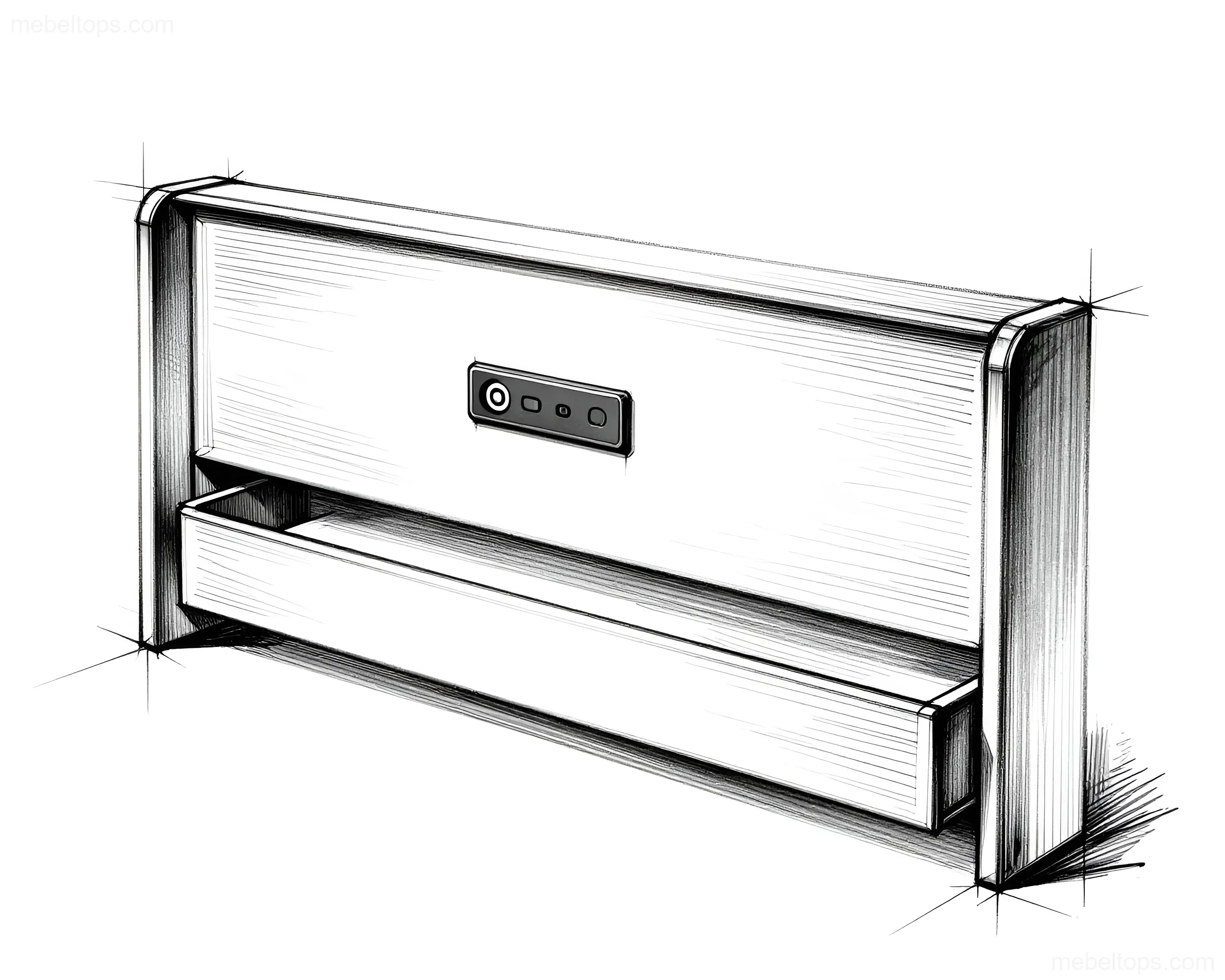
Another option is drawers in the lower part of the headboard (under the mattress or in the side posts). Drawer depth 20–25 cm, height 10–12 cm. Convenient for storing chargers, headphones, small items. Mechanism—full-extension ball slides with a soft-close feature so the drawer closes gently and without knocking.
Practical tip: if you plan to build in utilities, first determine the location of sockets and lamps in the wall, and then order the headboard. The reverse sequence (first the headboard, then the sockets "under it") almost always leads to the fact that the cutouts in the panel do not coincide with the sockets in the wall, and you have to either drill the panel or use extension cords that spoil the whole look.
Acoustic Comfort: How Soft Panels Reduce Noise in the Bedroom
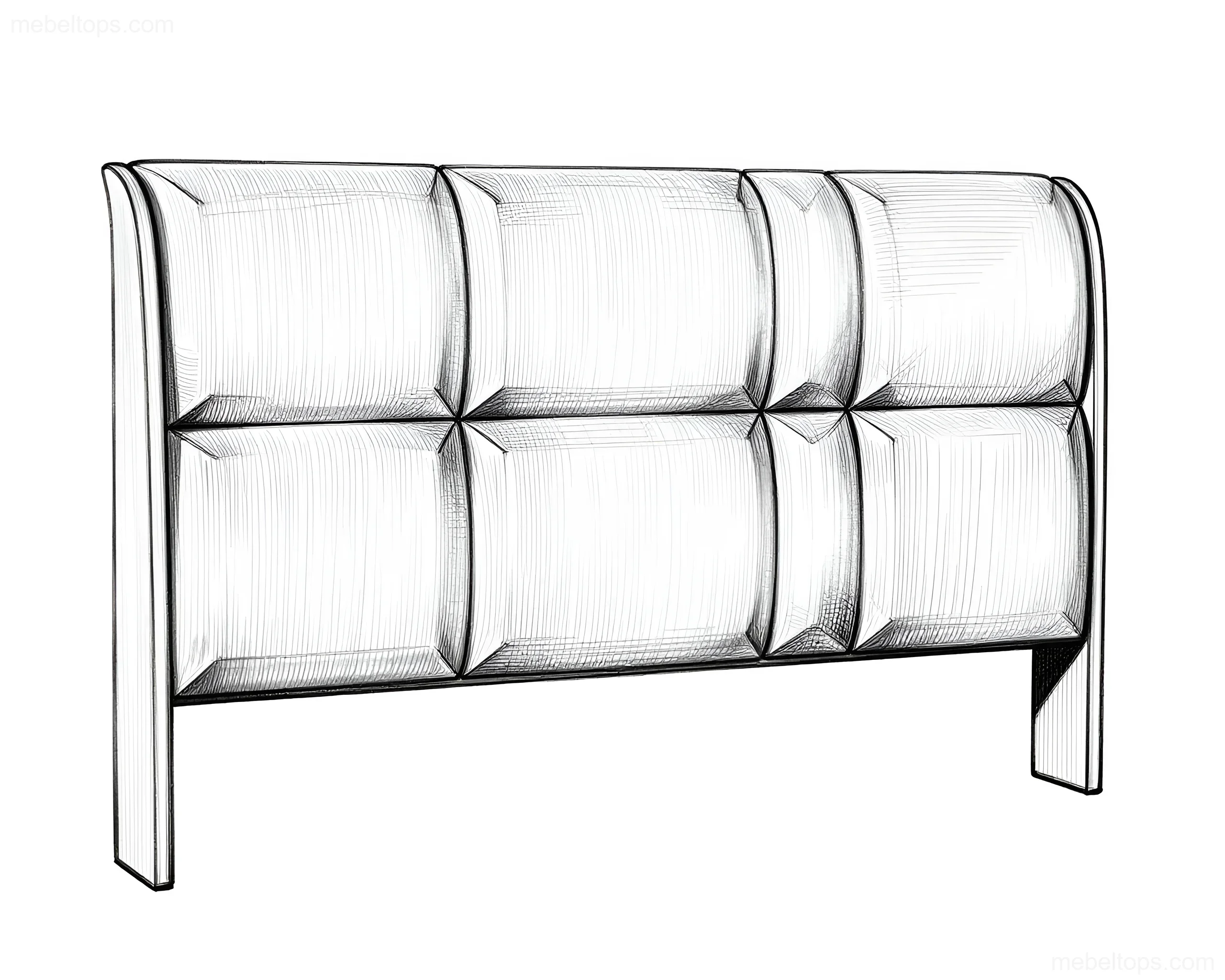
Little is said about this aspect of the headboard, but it really affects sleep quality. A soft headboard panel, especially with dense filler and fabric upholstery, works as an absorbing surface for sound waves in the medium and high-frequency range (from 500 Hz to 4 kHz). This is exactly the range where noise from the street, neighbors talking, ventilation hum, and other "annoying" sounds that interfere with falling asleep are located.
The Noise Reduction Coefficient (NRC) for a typical soft headboard with 8 cm foam and dense fabric upholstery is approximately 0.4–0.6. For comparison: a smooth drywall wall has an NRC of about 0.05–0.1, and a solid wood panel—0.1–0.2. That is, a soft headboard absorbs 4–6 times more sound than the wall behind it.
Of course, one headboard will not turn the bedroom into a soundproof capsule. But if you have a bedroom with a window to a noisy street, and the headboard stands against this wall, a soft panel will reduce the level of reflected noise in the room by 2–4 dB. This is not "silence," but it is the difference between hearing a muffled hum and hearing it with a "reflection" from a hard wall, which amplifies the perception of sound.
What enhances the sound-absorbing effect of the headboard:
- Large panel area. The wider the headboard (180 cm, 200 cm, 220 cm), the larger the absorption area. A narrow 140 cm headboard works noticeably worse.
- Dense filler. Foam 30–35 kg/m³ absorbs better than 20 kg/m³ because it has smaller pores and more "friction" inside the structure.
- Fabric with pile or texture. Basketweave, velour, brushed fabric create an additional surface for scattering sound waves. Smooth silk or satin are less effective.
- Absence of a rigid frame on the front side. If the panel "hangs" on a frame with a 2–3 cm gap from the wall, this air layer works as an additional resonator and enhances absorption in the low-frequency range (100–500 Hz).
If acoustic comfort is critical for you (for example, a bedroom on the ground floor, above the entrance group, or next to an elevator shaft), consider a headboard with a two-layer filler: top layer—soft foam 25 kg/m³ (5 cm), bottom—dense felt or mineral wool in a fabric cover (3–5 cm). Such a construction increases the NRC to 0.6–0.7 and additionally dampens low-frequency hum.
Important: sound absorption ≠ sound insulation. The headboard will not protect you from noise coming through the wall or window. But it will reduce the "echo" in the bedroom itself, make the sound more "soft" and less sharp, which is subjectively perceived as silence.
Hanging Pillows and Anti-Vandal Upholstery: Practicality in Details
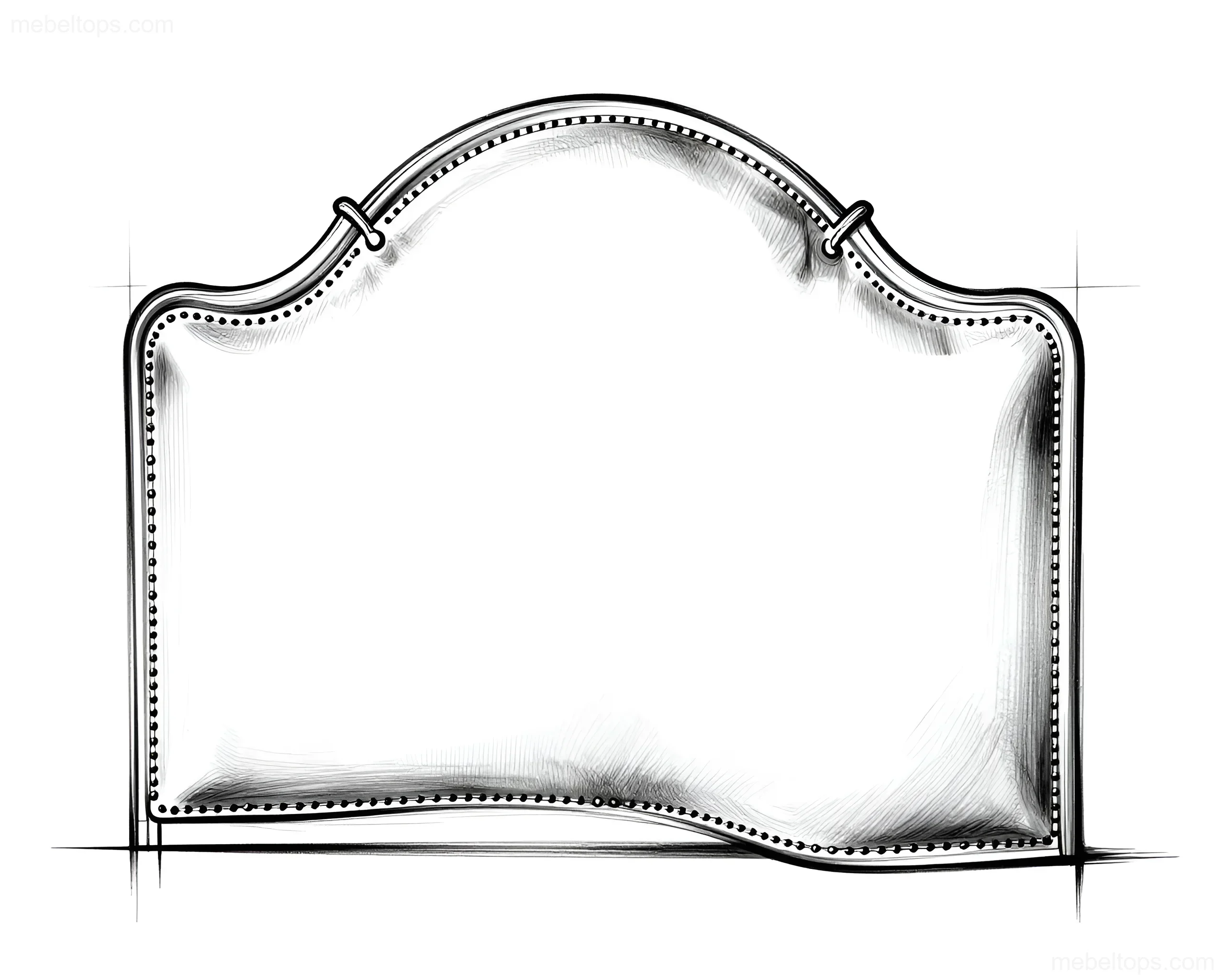
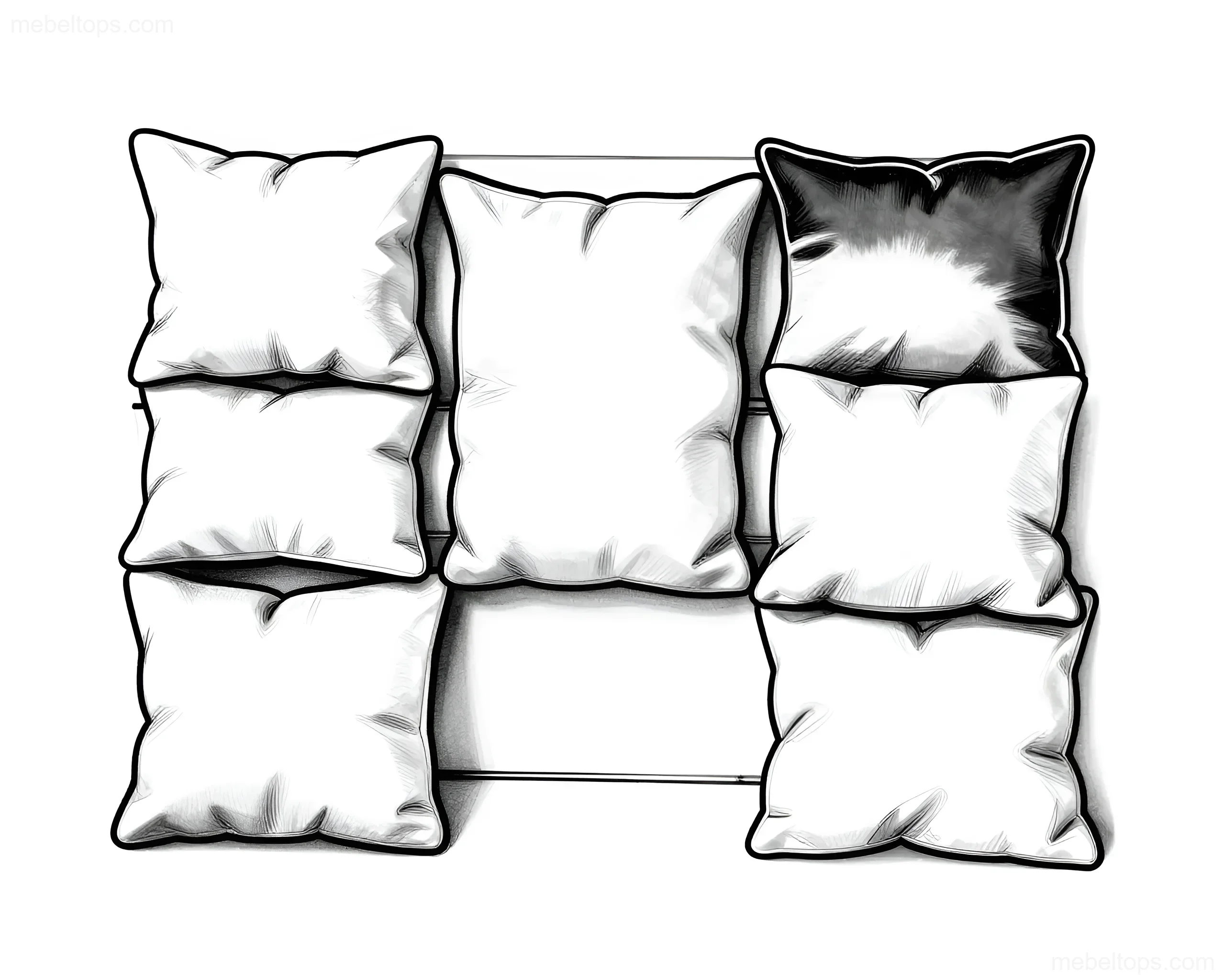
Hanging pillows are a separate category of headboards that is gaining popularity due to their flexibility and lightness. Unlike a monolithic panel, hanging pillows are attached to the wall or to the bed frame with hidden hinges, buttons, or magnetic fasteners. They can be removed, rearranged, replaced—and this is the main practical advantage.
Types of hanging pillow attachments:
- Buttons (snaps) — metal or plastic, diameter 12–15 mm. Quickly removed and attached, but can loosen over time. Suitable for pillows weighing up to 3 kg each.
- Hidden hinges — metal, sewn into the top edge of the pillow. The pillow "hangs" on the hinges like a picture. Reliable, but removing the pillow for washing is more difficult—you need to unfasten both hinges.
- Magnetic fasteners — neodymium magnets sewn into the pillow and installed on a metal bar on the wall. Removed with one movement, attached reliably. Minus: cannot be used near electronics (magnetic field).
- Rail system — aluminum or steel profile on the wall, to which pillows are attached on sliding brackets. Allows changing the order of pillows, adding new ones, removing them. The most flexible option for modular headboards.
The number of pillows in a hanging headboard is usually 2, 3, or 4. The width of each is 40–60 cm, height—50–70 cm. For a 160 cm bed, two 70 cm pillows are enough; for 180 cm—three 55–60 cm pillows; for 200 cm—four 50 cm pillows.
Anti-vandal upholstery. If there are children or pets in the bedroom, standard upholstery fabric may not withstand. Here is what to look for when choosing anti-vandal fabric:
- Martindale rating (wear resistance): for a bedroom with children and pets—from 40,000 cycles. For an "adult" bedroom without pets, 25,000–30,000 is enough. Standard furniture fabric—15,000–20,000 cycles.
- Pile: short (1–1.5 mm) or pileless. Long pile (more than 3 mm) collects animal hair and dust, and it is difficult to clean.
- Density: from 250 g/m². The denser the fabric, the less it tears and the harder it is for claws to pierce it.
- Impregnation: water-repellent impregnation (the "lotus" effect) will not save from spilled juice, but will give time to wipe the stain before it soaks in. For families with small children—a mandatory item.
Practical tip: if you choose hanging pillows, order one spare pillow (or at least a spare cover). In a year or two, the upholstery in the areas of constant leaning will wear out, and replacing one pillow with a new one is not replacing the entire headboard, but a local repair that takes 10 minutes.
For families with cats, it is especially important that the bottom edge of the pillow is not "free"—that is, it does not hang like a flap that can be grabbed with claws. Optimally, the bottom edge is sewn to a rigid bar or has a closed piping 3–5 cm wide.
Integration into Lighting Concepts: From Floor Lamps to Built-in LEDs
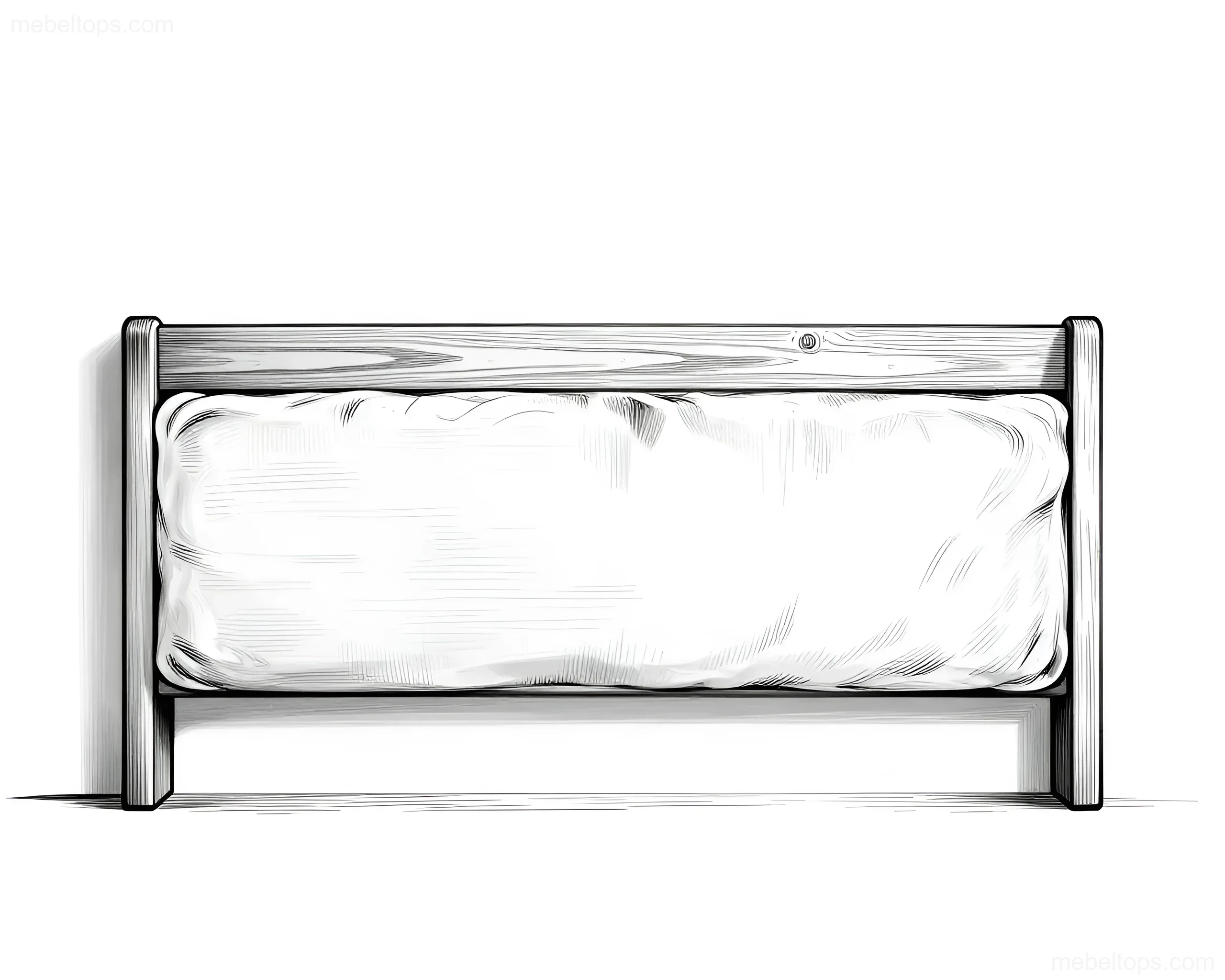
The headboard and lighting are two elements that work as a single system in the bedroom. Properly selected light in the headboard area is not only functional (illuminates for reading) but also sets the emotional tone of the space. Let's break down the main concepts.
Floor lamps on the sides. A classic option: two floor lamps on the sides of the bed, at a distance of 30–50 cm from the edge of the headboard. Floor lamp height—120–150 cm, lampshade at the level of 80–100 cm from the floor (at the eye level of a sitting person). LED lamp power in the lampshade—5–8 W, color temperature 2700 K. Minus of floor lamps: they take up space on bedside tables and can be inconvenient if the table is narrow (less than 40 cm).
Wall sconces. A more compact option. Mounted on the wall at a height of 80–90 cm from the floor, at a distance of 20–30 cm from the edge of the headboard. The lampshade is directed downwards or to the side so that the light does not shine into the eyes. Power 4–6 W (LED). Advantage over floor lamps: they do not take up space on tables, they don't get "knocked over" during rearrangement. Minus: wiring must be laid in advance, and the mounting height is fixed.
Built-in LEDs in the headboard. The most modern and flexible option. LED strip or spot lamps are built directly into the headboard construction. Placement options:
- Along the top edge — light is directed downwards, creates a soft "glow" of the panel and illuminates the reading area. Brightness 5–10 W/m, with a dimmer.
- Along the bottom edge — light is directed to the wall or downwards, creates a "floating" headboard effect. Brightness 3–5 W/m.
- Spot lamps — 2–4 lamps built into the panel, with direction adjustment. Power 3–5 W each. Convenient for reading: directed light on the book, while the rest of the room remains in twilight.
Combined lighting. An optimal scheme for the bedroom is three levels of light: background (ceiling, dimmed), functional (sconces or spots in the headboard for reading), and accent (LED lighting along the perimeter of the headboard or along the bottom edge). Control—using dimmers or smart home (Zigbee, Wi-Fi, Bluetooth protocol). A dimmer is especially important: for reading, you need light with a brightness of 300–500 lux on the book surface; for falling asleep—50–100 lux; for night waking—10–20 lux.
Practical tip: if you build LEDs into the headboard, order a power supply (adapter) with a 30% power reserve. For example, if the total power of the LED strip is 20 W, take a 30 W adapter. This will extend the life of the strip and prevent overheating. Place the adapter in the headboard niche or in the bedside table, not in plain sight.
Frequently Asked Questions and Interesting Facts About Headboards
Question: Can I make a headboard myself, without ordering from production?
Yes, and many do. Minimum set: plywood 10–12 mm (frame), foam 8 cm (filler), upholstery fabric, buttons or stitching, wall fasteners (anchors and dowels, or self-tapping screws into a wooden lath). There are dozens of instructions on YouTube and in masterclasses. The main thing is to calculate the load: a 160×100 cm headboard with foam weighs 8–12 kg, and the fastener must withstand not only the weight but also the lateral load when you lean back on the panel.
Question: How often should a soft headboard be cleaned?
Fabric upholstery—vacuum every 2–3 weeks (furniture attachment, "soft" mode). Deep cleaning (with a special fabric product)—every 6–12 months. Wooden headboard—wipe with a damp cloth once a week, polish with oil or wax every 6 months. Headboard with LED lighting—wipe with a dry cloth, do not use wet cleaning in the electronics area.
Question: What to do if the headboard has "sagged" in the leaning areas?
If a soft headboard has sagged—most likely, the filler has lost elasticity. Options: add a 3–5 cm layer of foam (if the construction allows), replace the filler (disassemble the panel, remove the old foam, insert new), or simply turn the panel 180° (if it is symmetrical). For a wooden headboard, "sagging" is not characteristic, but a squeak may appear—in this case, tighten the fasteners or add silicone sealant to the joints.
Question: Can a headboard be used as a space divider?
Yes, this is a common technique in studios and one-room apartments. A headboard panel 120–140 cm high and 200–250 cm wide, installed perpendicular to the wall, creates a visual boundary between the sleeping and working/living areas. In this case, the panel must be double-sided (upholstered on both sides) and have a rigid frame to withstand leaning from both sides. Fastening—to the floor and ceiling (if the construction allows) or to the wall with additional supports.


